Best Pizza in Boston’s North End: A Local’s Guide to the Styles

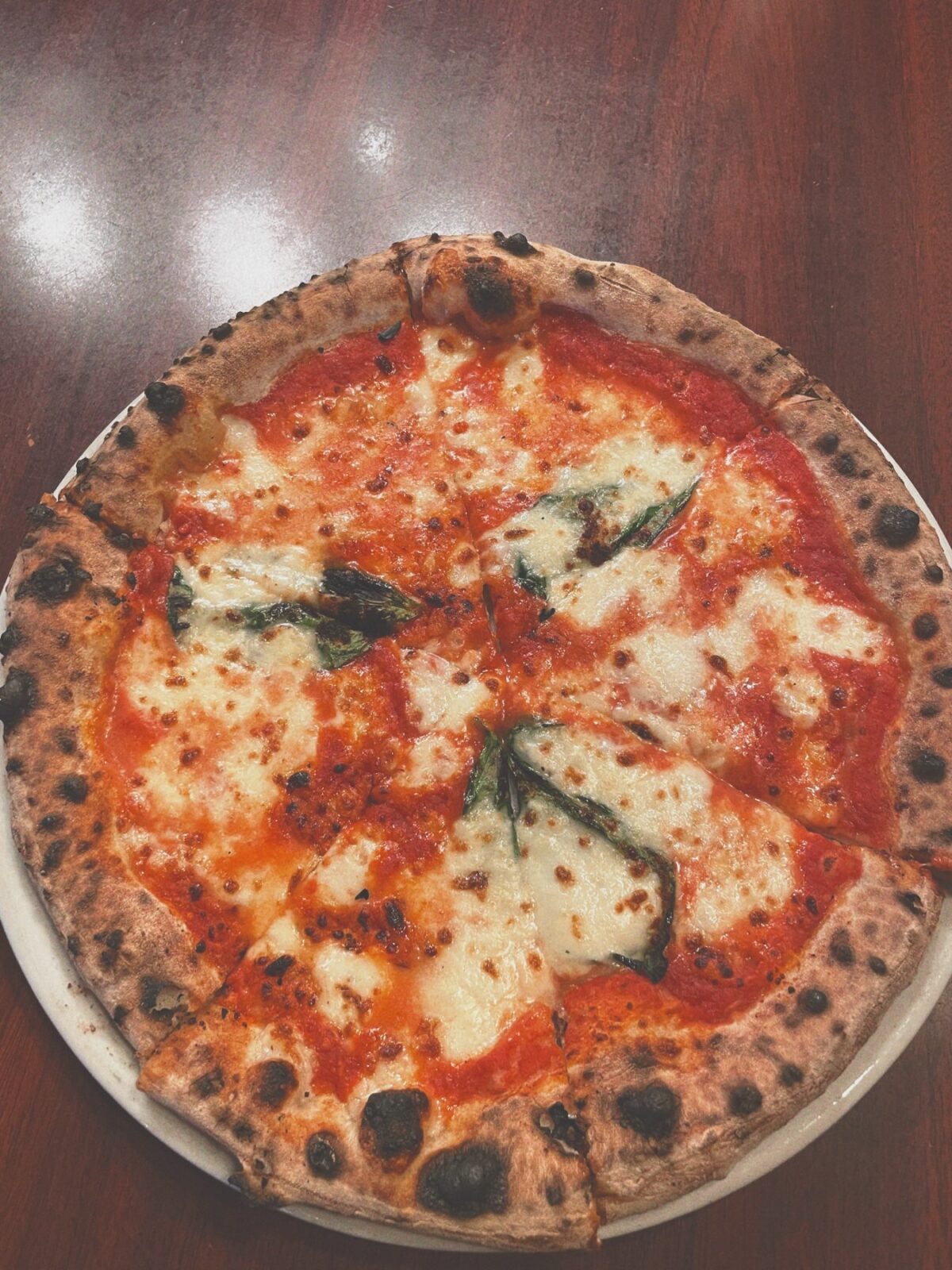
A lifelong North End local explains the neighborhood’s pizza styles, from Sicilian squares and bakery pizza to Neapolitan wood-fired pies, big slices, and the classic original.
A lifelong North End local explains the neighborhood’s pizza styles, from Sicilian squares and bakery pizza to Neapolitan wood-fired pies, big slices, and the classic original.
Spending Fourth of July in Boston? Here’s how to plan the North End around Harborfest, the waterfront, the Boston Pops fireworks, and a local food tour.
Coming to Boston for the 2026 World Cup? The matches are in Foxborough, but your real Boston day should include the North End: food, history, and a 3-hour local food tour.
Menu

Written by
Bobby Agrippino
Date
Apr 22, 2026
I’ve run a lot of bachelorette food tours through the North End. Dozens every year, more during the summer. And I can tell you without hesitation: these groups have the most fun of anyone I take out.
The reason isn’t complicated. A food tour is an activity that everyone in the group actually wants to do. Nobody’s opting out. Nobody’s bored. Nobody’s checking their phone waiting for it to be over. You’re eating incredible food, walking through one of the most beautiful neighborhoods in Boston, and spending real time together for three hours straight.
If you’ve ever tried to plan a bachelorette weekend, you know the nightmare. Half the group doesn’t want to do the bar crawl. Someone doesn’t drink. Someone else is watching their budget. A food tour sidesteps all of that. Everyone eats. Everyone walks. Everyone has a good time.
I’m not here to trash other activities. But I’ve heard enough stories from groups who’ve done them all to know what works and what doesn’t.
The bar crawl is fun for about four stops. Then someone taps out, someone else disappears, and the group that started as twelve is down to six by midnight. Half of you don’t remember the other half of it.
The cooking class sounds great in theory. In reality, you’re stuck in one room for two or three hours, it’s way more structured than you expected, and the group can’t really talk to each other because everyone’s focused on not burning something.
The spa day is relaxing, sure. But it’s not social. You’re separated for treatments, you’re in a quiet room where you can’t really talk, and the whole thing is over faster than you expected.
The escape room or group activity works if everyone’s into it. If even two people aren’t, it gets awkward fast. Forced fun has a ceiling.
A food tour is social for the entire three hours. You’re outdoors, walking through a gorgeous neighborhood, eating at every stop, and the pace is natural. Nobody gets burned out because there’s always something new happening. And by the end, you’ve had a full meal together plus enough stories to talk about for the rest of the weekend.
Here’s what the afternoon looks like, start to finish.
Your group meets me at the Tony DeMarco statue at 191 Hanover Street, right at the entrance to the North End. From there, I take you on about a three-hour walk through the neighborhood with six to eight tastings along the way.
Everything is pre-arranged. The maid of honor doesn’t have to coordinate a single thing. No calling ahead to restaurants, no juggling reservations, no figuring out logistics for twelve people. I handle all of it. Your only job is to show up hungry.
The group walks together, eats together, talks together. That’s the part that makes it work for bachelorette parties specifically. There’s no splitting off into subgroups. There’s no waiting for a table big enough to fit everyone. You’re all in the same place, having the same experience, the entire time.
Between stops, I tell stories about the neighborhood. My family has been in the North End since 1897, so these aren’t things I read in a guidebook. They’re what I grew up with. Your group gets to hear real history from someone who actually lived it.
The bride gets to feel special without having to plan anything. She shows up, she eats incredible food, she’s surrounded by her people. That’s it. No stress, no decisions, no logistics.
By the end of three hours, everyone is full. Nobody needs dinner. And you’ve got great photos from every corner of the neighborhood: cobblestone streets, historic architecture, colorful storefronts, and your whole group together in front of spots you can’t find anywhere else in the city.
A food tour isn’t the whole weekend. It’s the piece that makes the rest of the weekend better.
The Saturday afternoon slot. Most groups book the tour for Saturday afternoon, after brunch and before going out that night. It fills that gap perfectly. The food tour IS the afternoon. No scrambling to figure out what to do between brunch and dinner.
Perfect for out-of-towners. If half the group is flying in from out of state, the North End is one of the best neighborhoods in Boston to experience. It’s walkable, it’s historic, and it’s unlike anything they have at home. Your friends get something uniquely Boston instead of another generic activity they could do in any city.
Low logistics. Everyone walks over from downtown or the hotel. No splitting into rideshares, no hunting for parking, no meeting at some random location twenty minutes away.
Sets the tone for the rest of the weekend. After three hours of walking, eating, and laughing together, your group has shared stories and inside jokes that carry through Saturday night and into Sunday. The food tour bonds the group before the main event even starts.
Pairs well with evening plans. After the tour, you’re already in the North End. You’re in one of the best neighborhoods in the city for cocktails, dessert, or just walking around on a beautiful evening. The night starts right where the tour ends.
If you’re the one putting this together, here’s everything you need to know. I’ll make this easy.
Book early. Weekends fill up, especially from April through October. That’s peak bachelorette season and peak tour season at the same time. If you have a date, lock it in.
Group size is flexible. I run these for small groups and big ones. Whatever your party looks like, it works.
Price is about $100 per person. All food is included. Every single tasting, the full tour, the whole experience. No surprise costs, no splitting checks at eight different places, no one pulling out a calculator at the end. One price, everything covered.
Dietary restrictions? Not a problem. Vegetarian, gluten-free, allergies. Just tell me when you book and I’ll adjust the tastings. Nobody gets left out.
Duration is about three hours. Long enough to feel like a real experience, short enough that it doesn’t eat into the rest of your plans.
Rain or shine. All the tastings are indoors, so weather doesn’t cancel anything. You’ll walk between stops, but you’re not standing outside in the rain.
What should everyone wear? Comfortable walking shoes. That’s the only requirement.
Can the group bring props, sashes, the whole bachelorette setup? Absolutely. Bring the energy. The focus is on the food and the experience, but your group should feel like your group. I’ve seen tiaras, matching outfits, and enough “bride tribe” gear to fill a store. It all works.
The best bachelorette parties aren’t about the most expensive activity or the craziest night out. They’re about the bride spending real, uninterrupted time with her closest people.
A food tour gives you three hours of walking, eating, laughing, and actually being present with each other. No phones out because you’re too busy tasting something incredible. No splitting off into subgroups because you’re all together the whole time. No one checking the time because every stop brings something new.
That’s what people remember. Not the bar. Not the club. The afternoon they spent eating their way through the North End with their best friends.
Every bachelorette group I’ve taken out has told me the same thing afterward: this was the best part of the whole weekend.
If you’re planning a bachelorette party in Boston and you want an activity everyone will actually enjoy, let’s set it up. I’ve hosted over 3,000 five-star reviews worth of tours, and bachelorette groups are consistently some of the best afternoons I get to run.
Reach out to talk through the details for your group. I can help with timing, group size, dietary needs, and anything else you need to make it easy.
Tour details:
Call me at (617) 719-9542 if you have any questions and we can walk through the details.
Discover hidden gems, family-owned bakeries, legendary salumerias, and centuries of Italian history with authentic insider access. Taste, explore, and learn your way through Boston’s Little Italy on the tour everyone is talking about.
NORTH END BOSTON FOOD TOUR
Solo, Privates, Couples,
Groups, and Corporate tours.
617-719-9542
Meeting Location:
Tony DeMarco Statue,
191 Hanover St, Boston, MA 02113
PRIVACY POLICY
•
ACCESSIBILITY
Facebook
Instagram
Tiktok
Youtube
X-twitter
Linkedin
Pinterest
Get the latest bites and insider tips. Sign up for our newsletter!
North End Boston Food Tours © 2025, All rights reserved.
HOME
ABOUT US
CONTACT US
BOOK A TOUR
MEET YOUR TOUR GUIDE
LITTLE ITALY HISTORY
PARTNERS
GALLERY
REVIEWS
BLOG
FAQS
Powered by

Menu
Written by
Bobby Agrippino
Date
Apr 15, 2026
Most food tours work the same way. You sign up, you show up, and you spend three hours walking around with a group of strangers. It’s fun. I run public tours all the time and people love them.
But it’s a different experience when it’s just your people.
Private tours are some of my favorite to run. There’s no warming-up period where everyone’s figuring out each other’s pace or pretending to laugh at small talk with someone they just met. You skip straight to the good part: eating incredible food, hearing the stories behind this neighborhood, and actually enjoying it together.
If you’ve ever thought about booking a private food tour in Boston’s North End, here’s what that actually looks like.
On a public tour, I’m balancing the needs of a dozen people who don’t know each other. That’s fine, and I’m good at it. But a private tour lets me do something different.
The pace is entirely yours. If your group wants to linger at a stop because the conversation is good and the food is even better, you linger. If someone wants to take photos on a side street, the whole group stops. There’s no schedule to keep because the schedule belongs to you.
I can tailor the route. Want to go heavier on the savory stops? Done. More pastry-focused? I know exactly where to take you. Interested in the history of the neighborhood more than the food? I can spend more time on the stories and less time sitting down. The whole thing bends around what your group actually wants.
The storytelling goes deeper. On a public tour, I keep things accessible for everyone. On a private tour, if your group is full of history buffs, I can get into the real details. If they just want to eat and laugh, I keep it light. I read the room and adjust.
It feels less like a tour and more like a friend showing you around. That’s the thing people tell me afterward. It doesn’t feel like they booked a service. It feels like they spent an afternoon with someone who knows every corner of this neighborhood and genuinely wanted to share it with them.
You might think private tours are mostly for big groups or special occasions. They are, but they’re also for people who just want a better experience. Here’s who I see most often.
Birthdays and milestones. Turning 40, 50, 60? A private food tour through the North End beats dinner at a restaurant you’ll forget in a week. The birthday person gets to feel celebrated without having to plan anything.
Bachelorette and bachelor parties. This has become one of my most popular bookings. The group gets to eat incredible food, walk through a beautiful neighborhood, and actually talk to each other instead of shouting over music at a bar. It’s the part of the weekend everyone remembers.
Family reunions and visiting relatives. When your family is in town and you want to do something together that isn’t sitting around the living room, a food tour works for every generation. Grandparents love it. Kids love it. Everyone eats.
Date nights and anniversaries. A private tour for two is one of the most underrated date experiences in Boston. Three hours walking through the North End, tasting everything, hearing the stories. It’s more memorable than any reservation you’re going to make.
Corporate groups and team outings. Companies book private tours for team events all the time. It’s an easy win for whoever’s organizing because there’s nothing to coordinate, everyone has a great time, and nobody has to pretend to enjoy trust falls.
Tourists who want the real thing. Some people don’t want the group tour experience. They want someone who actually knows this neighborhood to show them around without rushing, without strangers, and without a generic script.
Here’s the logistics so you know exactly what you’re getting.
You meet me at the Tony DeMarco statue at 191 Hanover Street, right at the entrance to the North End. From there, I take your group on about a three-hour walk through the neighborhood with six to eight tastings along the way, all pre-arranged.
I handle everything. You don’t call ahead to places, you don’t make reservations, you don’t coordinate anything. I set up the entire route, arrange every tasting, and manage all the details. Your only job is to show up hungry.
The route can be customized. Want more pastry stops? I’ll build the route around the best bakeries in the neighborhood. Want it more savory? I know every deli counter and kitchen worth visiting. Want extra history? I can take you down streets most tours skip entirely and tell you what happened on every corner. My family has been in the North End since 1897, so the stories aren’t something I looked up. They’re just what I grew up with.
Dietary restrictions are no problem. Vegetarian, gluten-free, dairy-free, allergies. Just let me know ahead of time and I’ll adjust the tastings. Nobody gets left out and nobody settles for a side salad while everyone else eats.
The conversation is tailored to your group. This isn’t a rehearsed speech I give the same way every time. I pay attention to what your group is interested in and I lean into that. If you’re asking about the architecture, I’ll tell you about the buildings. If you want to know about the families who built this neighborhood, I’ve got those stories for days. If you just want to eat and have a good time, I keep it fun and light.
By the end of three hours, you’ve eaten enough to skip dinner, walked through corners of the North End most visitors never see, and spent an afternoon that actually felt like something.
Sometimes people want something more than the standard private tour, and I’m always happy to build something specific.
Extended tastings or extra stops. If your group wants more food or more variety, I can add stops to the route. More tastings, different types of food, a longer experience. It’s flexible.
Special occasion touches. I’ve arranged surprise stops for birthdays, set up something extra for anniversaries, and put together routes designed around a specific person’s interests. If you tell me what matters, I’ll make it part of the tour.
Flexible timing. Morning, afternoon, or evening. Most tours run in the afternoon, but if your group needs a different time, I’ll make it work. Evening tours through the North End have a completely different energy, and they’re worth experiencing.
Tailored to your group’s interests. History buffs get a different tour than foodies. First-time Boston visitors get a different tour than locals who’ve been coming to the North End for years. I adjust everything so it feels right for the people who are actually on it.
Group size? Flexible. I run private tours for couples, small groups, and large parties. Whatever your group looks like, I’ll make it work.
How far in advance should I book? The earlier the better, especially for weekends and peak season (spring through fall). Popular dates fill up fast. If you’re planning something for a specific occasion, don’t wait.
How much does it cost? About $100 per person, all-inclusive. Every tasting, the full tour, and a guide who actually knows this neighborhood inside and out. No hidden fees.
How long is the tour? About three hours. Long enough to be a real experience, short enough that it doesn’t take over your whole day.
What about dietary restrictions? Fully accommodated. Just let me know when you book.
What if it rains? Rain or shine. All the tastings are indoors, so weather doesn’t change the experience. You’ll be walking between stops, but you won’t be standing outside in the rain.
If you’re planning something for a group, a date, a birthday, or just want the North End without the crowds and the strangers, let’s set it up.
I’ve hosted over 3,000 five-star reviews worth of tours, and private bookings are some of the best experiences I get to create. Every one is different because every group is different. That’s the whole point.
Tour details:
Call me at (617) 719-9542 to talk through the details for your group.
Discover hidden gems, family-owned bakeries, legendary salumerias, and centuries of Italian history with authentic insider access. Taste, explore, and learn your way through Boston’s Little Italy on the tour everyone is talking about.
NORTH END BOSTON FOOD TOUR
Solo, Privates, Couples,
Groups, and Corporate tours.
617-719-9542
Meeting Location:
Tony DeMarco Statue,
191 Hanover St, Boston, MA 02113
PRIVACY POLICY
•
ACCESSIBILITY
Facebook
Instagram
Tiktok
Youtube
X-twitter
Linkedin
Pinterest
Get the latest bites and insider tips. Sign up for our newsletter!
North End Boston Food Tours © 2026, All rights reserved.
HOME
ABOUT US
CONTACT US
BOOK A TOUR
MEET YOUR TOUR GUIDE
LITTLE ITALY HISTORY
PARTNERS
GALLERY
REVIEWS
BLOG
FAQS
Powered by
A North End native’s guide to fueling up for the Boston Marathon. What to eat the night before, race morning, and after the finish line, from a neighborhood built for carb loading.
Menu
Written by
Bobby Agrippino
Date
Apr 8, 2026
You’re thinking about doing a food tour in Boston’s North End. Maybe someone recommended it. Maybe you saw the reviews. Either way, you’ve got questions. What do you actually eat? How much walking is it? Is it worth the money? Do you need to be some kind of foodie to enjoy it?
Here’s everything you need to know before you book, before you show up, and what happens once the tour starts. No surprises.
A few things that’ll make your afternoon better if you know them ahead of time.
Don’t eat a big meal before the tour. This is the number one mistake people make. They have a full brunch, show up, and by the third tasting they’re struggling. Come hungry. A light breakfast or a small coffee is fine. You’re going to eat a lot over the next three hours, and you want to enjoy every stop.
Wear comfortable shoes. You’ll be walking through the North End for about three hours. It’s not a hike. The pace is relaxed, and there are plenty of stops along the way. But you’re on your feet, on cobblestone streets in some places, so save the heels for later.
You don’t need to bring cash. Everything is included in the ticket price. All the tastings, the full tour, the whole experience. You’re not going to be pulling out your wallet at any point. If you want to tip at the end, that’s appreciated but not expected.
Getting there is easy. The meeting point is right at the entrance to the North End, steps from downtown. If you’re taking the T, Haymarket station is the closest stop. If you’re driving, there are parking garages nearby on Commercial Street and at the Parcel 7 garage above Haymarket. Most people walk over from their hotel or from downtown.
Show up a few minutes early. Not because I’m strict about it, but because the tour starts on time and you don’t want to spend the first stop catching up.
Every tour meets at the Tony DeMarco statue at 191 Hanover Street. It’s a bronze boxing statue right at the corner where Hanover Street enters the North End. You can’t miss it.
I’ll be there waiting. I usually have a group of anywhere from a handful of people to a dozen or more. We do quick introductions, I give a short overview of what the next three hours are going to look like, and then we start walking.
Within two minutes, you’re in the heart of the neighborhood.
This is the part everyone wants to know about, so let me be specific.
You’ll have six to eight tastings over about three hours. These aren’t tiny sample-size bites. At most stops, you’re sitting down and eating a real portion. By the end of the tour, you’ve had a full meal. Most people skip dinner afterward.
The tastings cover the full range of what the North End does best. Think fresh pasta, cured meats, pizza that’s been made the same way for decades, imported cheeses, handmade pastries, and espresso from places that have been roasting their own beans longer than most coffee shops have existed. Every stop is a different style and a different part of the neighborhood’s food tradition.
Nothing is generic. You’re not eating at the tourist spots with the biggest signs on Hanover Street. You’re eating at the places I’ve been going to my whole life. Family-run kitchens. Bakeries that don’t need a social media presence because the line out the door does the marketing for them. Counters where the owner knows my name because my family has been in the North End since 1897.
There’s variety at every stop. One tasting might be savory, the next one sweet. You’ll try things you’ve never had before and things you thought you knew but never had made like this. The whole tour is designed so that nothing feels repetitive and every stop has its own personality.
Dietary restrictions are fully accommodated. Vegetarian, vegan, gluten-free, dairy-free, allergies. Just let me know when you book. I adjust the tastings so that everyone eats well at every stop. Nobody gets a sad substitute plate while everyone else enjoys the main event.
People ask about this a lot, so here’s the honest answer.
The total walking distance is about a mile and a half. That’s spread over three hours with six to eight stops along the way. You’re never walking more than a few blocks before you’re sitting down and eating again.
The pace is relaxed. This isn’t a power walk through the neighborhood. I stop to point things out, tell stories, and let people take photos. If someone needs a minute, the group waits. There’s no rushing.
The streets are mostly flat. The North End isn’t hilly. There are a few cobblestone stretches and some uneven sidewalks, but nothing that requires any special fitness. I’ve had guests in their 80s do the full tour without any issues.
You’ll see parts of the neighborhood most visitors miss. The tour doesn’t just stick to Hanover Street. I take you down side streets, through quieter corners, and past buildings with stories that you’d walk right past if you didn’t know to look.
A food tour that’s just eating is fine. But the food is better when you know the story behind it.
Between stops, I talk about the North End. Not a rehearsed lecture. More like the stuff I’d tell a friend visiting for the first time. How this neighborhood became Boston’s Little Italy. The families who built the restaurants and bakeries you’re eating at. What these streets looked like fifty years ago, and what’s still exactly the same.
I grew up with these stories. They’re not something I researched for the job. They’re just part of growing up in a neighborhood where everyone knows everyone and every corner has a history.
You’ll hear about the architecture, the culture, and the people. The North End is one of the oldest continuously inhabited neighborhoods in America. There’s a lot to talk about, and I adjust based on what the group is interested in. If you’re asking questions about the history, I go deeper. If you just want to eat and enjoy the walk, I keep it light.
The stories are the part that turns a food tour into something you actually remember. Anyone can point you to a good bakery. I can tell you why it matters.
I’ve run thousands of these tours. Here are the things people worry about that they don’t need to.
“I’m not really a foodie.” You don’t need to be. You just need to like eating. The food is approachable, it’s delicious, and I explain everything before you try it. Nobody’s going to quiz you on flavor profiles or expect you to know the difference between types of pasta. You eat, you enjoy it, that’s it.
“I’m a picky eater.” Let me know ahead of time and I’ll work with you. I’ve accommodated just about every preference and restriction you can think of. The point is for everyone to eat well, not to challenge anyone’s comfort zone.
“I don’t know anyone else on the tour.” That’s normal. Most public tours are a mix of couples, families, solo travelers, and small groups who don’t know each other at the start. By the second stop, everyone’s talking. Food does that. By the end, people are exchanging numbers and restaurant recommendations. It’s one of the things I like most about running these.
“Is it really worth $100?” You’re getting six to eight tastings that add up to more than a full meal, a three-hour guided experience through one of Boston’s best neighborhoods, and local knowledge from someone who actually grew up here. If you priced out the food alone and bought it yourself, you’d spend close to that, and you’d be standing in line at every place without knowing what to order. The tour is the better deal.
“What if it rains?” All the tastings are indoors. You’ll walk between stops, and a little rain doesn’t change the experience. I run tours in every kind of weather. Bring an umbrella if you want, but don’t cancel.
A few things that’ll make your experience even better.
Come hungry. I said it already but it’s worth repeating. Light breakfast, empty stomach, ready to eat. That’s the move.
Bring a light layer. Boston weather can shift, especially in spring and fall. Even on a warm day, some of the stops are air-conditioned and the side streets can be breezy.
Leave the itinerary open afterward. You’ll be in the North End when the tour ends, which is one of the best spots in the city to keep exploring. Grab a cocktail, walk along the waterfront, sit in a cafe. Don’t schedule something across town for right after the tour.
Ask questions. Seriously. I’d rather have a group that’s curious and asking about everything than a group that stays quiet. Ask about the food, the neighborhood, the history. That’s what makes the tour yours.
Phones are fine, but you won’t need them much. People always start the tour with their phones out taking photos. By the third stop, most people put them away because they’re too busy eating, talking, and laughing. That’s a good sign.
If you’ve been thinking about it, this is your sign. I’ve hosted over 3,000 five-star reviews worth of tours, and the thing I hear most often at the end is: “I wish I’d done this sooner.”
Three hours. Six to eight tastings. One of the best neighborhoods in the country. And a guide who actually grew up here and wants to share it with you.
Tour details:
Discover hidden gems, family-owned bakeries, legendary salumerias, and centuries of Italian history with authentic insider access. Taste, explore, and learn your way through Boston’s Little Italy on the tour everyone is talking about.
NORTH END BOSTON FOOD TOUR
Solo, Privates, Couples,
Groups, and Corporate tours.
617-719-9542
Meeting Location:
Tony DeMarco Statue,
191 Hanover St, Boston, MA 02113
PRIVACY POLICY
•
ACCESSIBILITY
Facebook
Instagram
Tiktok
Youtube
X-twitter
Linkedin
Pinterest
Get the latest bites and insider tips. Sign up for our newsletter!
North End Boston Food Tours © 2025, All rights reserved.
HOME
ABOUT US
CONTACT US
BOOK A TOUR
MEET YOUR TOUR GUIDE
LITTLE ITALY HISTORY
PARTNERS
GALLERY
REVIEWS
BLOG
FAQS
Powered by
Menu
Written by
Bobby Agrippino
Date
Apr 1, 2026
Boston’s North End is one of those neighborhoods that rewards you just for showing up. The narrow streets, the smell of fresh bread, the espresso bars that haven’t changed their recipes in decades — it’s all there whether you plan for it or not.
So when people ask me whether they should do a self-guided food tour or book a guided one, my honest answer is: you’re going to eat well either way. The North End kind of guarantees that.
But there are real differences between the two experiences. And if you’re trying to figure out which one is actually worth your time and money, here’s the honest breakdown.
Let’s give credit where it’s due — a self-guided walk through the North End is a perfectly good time. You stroll down Hanover Street, pop into a bakery, grab a cannoli, maybe sit in a cafe and people-watch for a while. If you’ve done a little research beforehand, you probably have a list of the big-name spots and you’ll hit most of them.
The appeal is obvious: it’s free (minus whatever you eat), you go at your own pace, and nobody’s telling you where to be at what time. If you’re the kind of person who likes to wander, that flexibility is genuinely nice.
Here’s what you might not realize until you’re there, though. The North End is surprisingly easy to scratch the surface of without ever going deeper. Most visitors end up walking the same two or three blocks, eating at the same handful of places they saw on TikTok, and heading home thinking they saw the neighborhood.
They didn’t. Not really.
When people hear “guided food tour,” they picture someone with a clipboard walking you past landmarks and reading from a script. That’s not what this is.
My family has been in the North End since 1897. So when I run a food tour, it’s not a scripted walking presentation — it’s more like tagging along with someone who knows every back door, every family-run kitchen, and every story behind the storefronts you’d walk right past on your own.
Here’s what that actually looks like:
You go where locals go, not where tourists line up. The North End has spots with no signage, places tucked down side streets, and counters that don’t bother with social media because they don’t need to. You’re not going to find these on a Google search. You find them because someone who grew up here — me — takes you there.
The food is pre-arranged. That means no standing in line for 45 minutes, no squinting at a menu trying to figure out what’s good, no awkward moment where you order the wrong thing at a place that does one thing really well. You show up, you sit down, the food comes out. Six to eight curated tastings over about three hours — and yes, all of it is included in the price.
You get the stories. Who opened this place and why. What this block looked like 50 years ago. Why the old guys still play bocce in the park on Sundays. The North End isn’t just a food neighborhood — it’s one of the oldest residential neighborhoods in the country, and the history is baked into every corner of it. But you’d never know that walking Hanover Street with your phone out.
You leave actually full. This isn’t a “sample a bite and move on” situation. By the end of three hours, you’ve had a real meal — appetizers, entrees, pastries, espresso. Most people skip dinner afterward.
| Self-Guided | Guided Food Tour | |
|---|---|---|
| Cost | Free (plus food purchases) | ~$100/person, all food included |
| Time | However long you want | ~3 hours |
| Food included | No — you buy as you go | Yes — 6-8 tastings included |
| Local knowledge | Only what you research | Led by a lifelong local |
| Lines and wait times | You wait like everyone else | Pre-arranged, no waiting |
| Hidden spots | Unlikely to find them | That’s the whole point |
| Good for groups | Hard to coordinate | Built for it |
I’m not going to pretend a guided tour is the right call for everyone. If you’re on a tight budget and just want to grab a cannoli and a slice, walk around, and soak it in — do that. The North End doesn’t charge admission.
If you’ve been to the neighborhood a bunch of times and you already have your go-to spots, you probably don’t need someone showing you around. And if you genuinely prefer no structure at all — no schedule, no group, just you and the cobblestones — a self-guided walk is a perfectly good afternoon.
No judgment. Seriously.
If any of these sound like you, a guided tour is going to be the better experience:
You’re visiting for the first time. You don’t know what you don’t know. A guide fills in all the gaps — where to go, what to order, what to skip — so you don’t waste your one shot at the North End on a mediocre tourist trap.
You’re with a group. Trying to get six or eight people to agree on where to eat is a special kind of torture. A guided tour takes that decision off the table entirely. Everyone eats, everyone’s happy, nobody has to be the one who picks the restaurant.
It’s a special occasion. Bachelorette parties, birthdays, anniversaries, corporate outings — a food tour is one of those things that sounds fun in theory and actually delivers. It’s social, it’s memorable, and nobody has to plan anything.
You’re a couple looking for something different. Dinner reservations are fine. But walking through the North End for three hours, tasting everything, hearing the stories — that’s a date you’ll actually remember.
You want the real North End. Not the Instagram version. Not the Yelp top-10 version. The actual neighborhood, with its hidden corners and family stories and food that people have been making the same way for generations.
My tour runs about three hours and includes six to eight tastings — enough food that you won’t need dinner. My family has been in this neighborhood since 1897, and I’ve spent my whole life here. I’m not reading from a script — I’m showing you my neighborhood.
Tour details:
Over 3,000 five-star reviews from people who came in curious and left as North End regulars.
Discover hidden gems, family-owned bakeries, legendary salumerias, and centuries of Italian history with authentic insider access. Taste, explore, and learn your way through Boston’s Little Italy on the tour everyone is talking about.
NORTH END BOSTON FOOD TOUR
Solo, Privates, Couples,
Groups, and Corporate tours.
617-719-9542
Meeting Location:
Tony DeMarco Statue,
191 Hanover St, Boston, MA 02113
PRIVACY POLICY
•
ACCESSIBILITY
Facebook
Instagram
Tiktok
Youtube
X-twitter
Linkedin
Pinterest
Get the latest bites and insider tips. Sign up for our newsletter!
North End Boston Food Tours © 2025, All rights reserved.
HOME
ABOUT US
CONTACT US
BOOK A TOUR
MEET YOUR TOUR GUIDE
LITTLE ITALY HISTORY
PARTNERS
GALLERY
REVIEWS
BLOG
FAQS
Powered by
Escape rooms and bowling alleys don’t build real teams. A North End food tour does. Here’s why companies are booking guided food tours for team outings in Boston.
Discover the best limoncello in Boston at V. Cirace & Son, a 120-year-old North End wine shop. Learn the story behind Sogno di Sorrento and taste it on our food tour.
My family has been in the North End since 1897. Here’s why Boston’s Little Italy is the perfect place to bring your kids — and what a family food tour is actually like.
Menu
Written by
Bobby Agrippino
Date
Feb 26, 2026
I’ve been around Italian food my entire life.
North End kitchens. Family recipes. Classic red sauces. Dishes everyone knows and orders without even looking at the menu.
And still, Rigatoni alla Boscaiola surprises people.
Half the people who try it say the same thing:
“I’ve never heard of this before… but this is incredible.”
That’s why I call it the best pasta you’ve probably never tried.
“Boscaiola” means woodcutter’s style.
The dish comes from central Italy, where woodcutters would forage mushrooms and cook hearty meals built from simple, powerful ingredients. Mushrooms. Cured pork. Onions. Something rich and satisfying after a long day of work.
It wasn’t meant to be fancy. It was meant to be filling. Flavorful. Real.
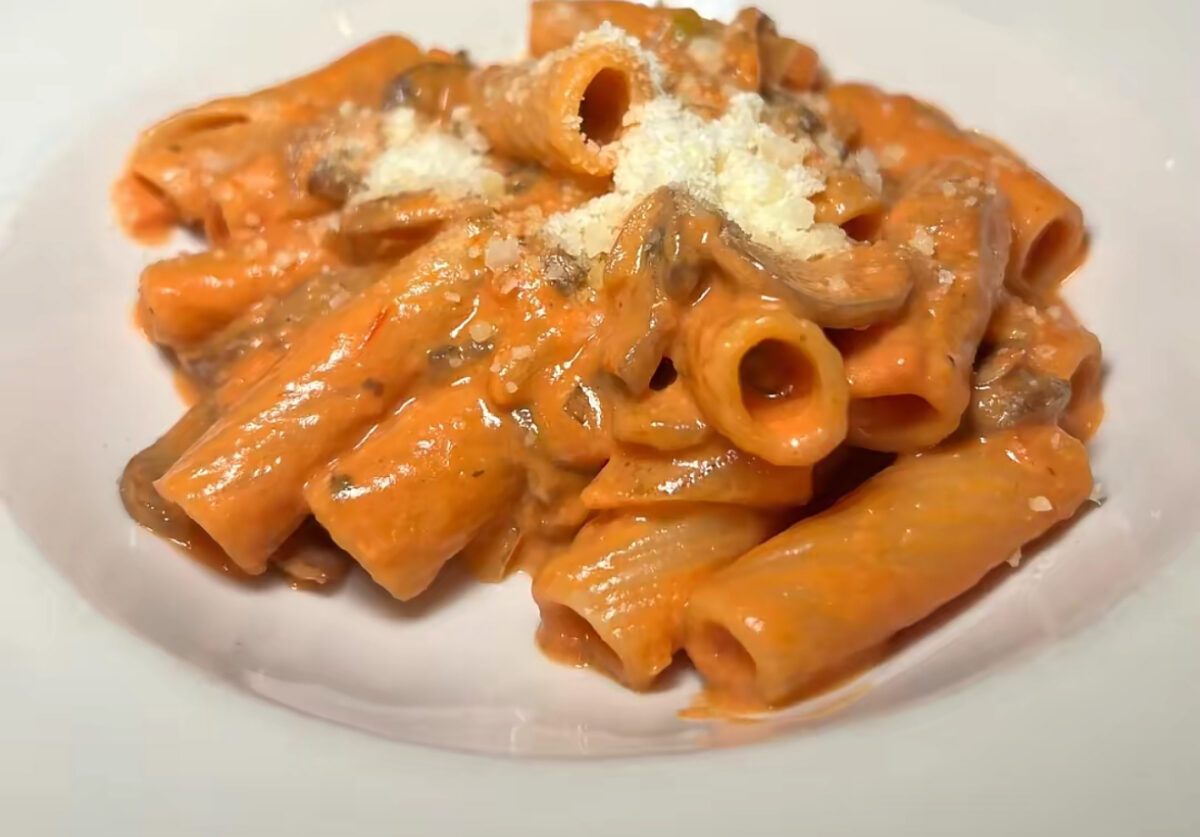
Over time, different regions put their spin on it. Some versions are cream-based. Some use tomatoes. At Antico Forno, a classic Italian restaurant at 93 Salem St. in Boston’s North End, the kitchen brings those elements together.
The Rigatoni alla Boscaiola is made with:
The San Marzano tomatoes give it structure and a natural sweetness. The mascarpone smooths everything out and adds richness without making it heavy. The mushrooms bring depth. The Italian ham gives you that savory bite. The peas add just enough contrast to keep it interesting.
And the rigatoni matters.
Those ridges hold the sauce. The hollow center traps it. You’re not getting a thin coating. You’re getting a full bite every time.
If you usually default to vodka sauce, bolognese, or carbonara, this is your moment to try something different without stepping too far outside your comfort zone.
Rigatoni alla Boscaiola feels familiar, but it has its own personality. It’s hearty without being overwhelming. Rustic but refined. The kind of dish you finish and immediately think, I’m ordering that again next time.
My family has been in the North End since 1897. Five generations in this neighborhood. I grew up eating in these kitchens, watching nonne roll pasta, and learning that the best Italian food isn’t always the dish with the longest line or the most Instagram posts.
Boscaiola is one of those dishes.
When I built the North End Boston Food Tour, I knew Antico Forno had to be a stop, and this dish had to be part of it. Not because it’s trendy. Because it tells a story. The woodcutter’s pasta, made with simple ingredients, done right, in a neighborhood that’s been cooking this way for over a century.
That’s the whole point of the tour. I’m not taking you to the places everyone already knows about. I’m showing you the dishes and the stories that make this neighborhood what it actually is, the stuff you’d never find on your own unless you grew up here.
Antico Forno is open seven days a week at 93 Salem St. in Boston’s North End. The Rigatoni alla Boscaiola is on the dinner menu, and if you ask anyone who’s had it, they’ll tell you it’s one of the most underrated dishes in the neighborhood.
Walk in. Sit down. Order the dish nobody talks about but everybody remembers.
NORTH END BOSTON FOOD TOUR
Solo, Privates, Couples,
Groups, and Corporate tours.
617-719-9542
Meeting Location:
Tony DeMarco Statue,
191 Hanover St, Boston, MA 02113
PRIVACY POLICY
•
ACCESSIBILITY
Facebook
Instagram
Tiktok
Youtube
X-twitter
Linkedin
Pinterest
Get the latest bites and insider tips. Sign up for our newsletter!
North End Boston Food Tours © 2025, All rights reserved.
HOME
ABOUT US
CONTACT US
BOOK A TOUR
MEET YOUR TOUR GUIDE
LITTLE ITALY HISTORY
PARTNERS
GALLERY
REVIEWS
BLOG
FAQS
Powered by
Menu
Written by
Bobby Agrippino
Date
Feb 23, 2026
Walk down Hanover Street today and you’ll see pastry shops, trattorias, espresso bars, and tourists snapping photos of every corner. The North End feels like it’s always been this way, a proud, thriving Italian neighborhood at the heart of Boston.
But a hundred years ago, these same streets told a very different story. This was a neighborhood fighting to survive. And the people who lived here were fighting just to belong.
The Italian immigrants who settled in the North End in the early 1900s didn’t speak English. They weren’t considered fully American. Many worked the lowest-paying jobs the city had to offer, digging tunnels, hauling freight, laying bricks.
Signs in shop windows and boarding houses read “No Italians.” Newspapers ran cartoons depicting them as criminals. The message was clear: you are not welcome here.
And then something happened right here in Massachusetts that shook every Italian neighborhood in America.
In 1920, two Italian immigrants, Nicola Sacco and Bartolomeo Vanzetti, were arrested for armed robbery and murder in Braintree, Massachusetts. The evidence was thin. The trial was riddled with bias. The judge openly referred to them as “anarchist bastards.”
They were convicted. Appeals were denied. And on August 23, 1927, both men were executed.
To Italians in the North End, the Sacco and Vanzetti case wasn’t just a trial. It was a message from the country they’d come to call home: You don’t belong.
Protests erupted across the world, from London to Buenos Aires. But in the Italian neighborhoods of Boston and New York, something deeper was happening. The grief was turning into resolve.
In New York, a man named Generoso Pope Sr. was watching all of this unfold. Pope owned Il Progresso Italo-Americano, the largest Italian-language newspaper in the United States, with a readership that stretched from Manhattan to Boston to Chicago.
What Pope told his readers wasn’t “keep your head down.”
He told them: Become citizens. Register to vote. Build influence. Be proud of who you are.
Pope used his newspaper to rally Italian immigrants toward civic participation. He endorsed candidates, organized voter drives, and pushed the message that political power was the path to respect. He became one of the most influential Italian Americans in the country, advising mayors, governors, and even presidents.
That mindset, organize, show up, demand a seat at the table, spread to every Italian enclave in America. Including the streets right here in the North End.
By the time the next generation came up, the children and grandchildren of those first immigrants, Italians in Boston weren’t hiding anymore.
The feasts got bigger. The Saint’s Day processions got louder. The smell of Sunday sauce drifted out of every triple-decker in the neighborhood.
And the politicians? They stopped ignoring the North End. They started showing up, shaking hands, and asking for votes.
Italian Americans weren’t outsiders anymore. They were police officers. Firefighters. Union leaders. Business owners. City councilors. And yes, eventually, even Presidents of the United States.
This is what makes the North End more than a food destination. Every restaurant, every bakery, every festival on these streets exists because a community refused to disappear.
When you bite into a cannoli on Hanover Street, you’re not just tasting dessert. You’re tasting a neighborhood that fought, for generations, to be seen, to be heard, and to be proud.
Want to hear stories like this in person? The North End Food & History Tour takes you through the streets, the food, and the real history behind Boston’s most famous neighborhood. Book your tour today!
NORTH END BOSTON FOOD TOUR
Solo, Privates, Couples,
Groups, and Corporate tours.
617-719-9542
Meeting Location:
Tony DeMarco Statue,
191 Hanover St, Boston, MA 02113
PRIVACY POLICY
•
ACCESSIBILITY
Facebook
Instagram
Tiktok
Youtube
X-twitter
Linkedin
Pinterest
Get the latest bites and insider tips. Sign up for our newsletter!
North End Boston Food Tours © 2025, All rights reserved.
HOME
ABOUT US
CONTACT US
BOOK A TOUR
MEET YOUR TOUR GUIDE
LITTLE ITALY HISTORY
PARTNERS
GALLERY
REVIEWS
BLOG
FAQS
Powered by
Written by
Bobby Agrippino
Date
Feb 20, 2026
If you’re searching for the best Boston Restaurant Week menu in the North End, two names should be on your list: Antico Forno and Terramia.
Both restaurants are owned by Carla Gomes and are located in the heart of Boston’s North End. During Dine Out Boston 2026, they are offering curated prix fixe menus that showcase classic Italian cooking with distinct personalities.
This guide breaks down:
• What makes each restaurant different
• What to expect during Boston Restaurant Week
• Why they consistently rank among top North End Italian restaurants
• How to decide which experience is right for you
And yes, we’ll break down the full Restaurant Week menus once finalized.
Boston Restaurant Week, now often branded under Dine Out Boston, is a seasonal culinary event where participating restaurants offer prix fixe menus at special pricing.
For diners, it’s a chance to experience high-end restaurants at approachable price points.
Three-Course Prix Fixe – $46
Available February 22 through March 7, 2026
All guests at the table must participate in the prix fixe.
Terramia is intimate, polished, and slightly more refined. The menu blends traditional Italian comfort with elevated presentation.
Arancini
Crispy rice balls filled with bolognese, peas, and fontina cheese, served with San Marzano tomato sauce. Savory, rich, and deeply comforting.
Zuppa di Pomodoro (V, GF)
Oven roasted tomato soup with garlic, basil, and fresh buffalo mozzarella. Bright acidity meets creamy depth.
Insalata di Arugula (V, GF)
Wild organic arugula, shaved fennel, fresh orange segments, and Italian honey dressing. Clean, citrus-forward, refreshing.
Polpette
Oven baked meatballs in San Marzano tomato sauce finished with Parmigiano. Classic, hearty, crowd favorite.
Pappardelle alla Bolognese (GF option available)
Broad ribbon pasta with traditional veal, beef, and pork ragù, basil, and Parmigiano. Deep, slow-cooked flavor.
Spaghetti con Polpette
Spaghetti with baked meatballs in tomato sauce and Parmigiano. Familiar, satisfying, timeless.
Pollo Marsala (GF)
Organic chicken breast with wild mushrooms, smoked pancetta, herb roasted potatoes, and Marsala cream sauce. Earthy, rich, and layered.
Pesce (GF)
Pan seared salmon with mustard-crab crust, mashed potato, string beans, and citrus reduction. Balanced and elegant.
Vegano Ravioli (V)
Zucchini, eggplant, red bell pepper, and tomato-filled ravioli with aglio e olio or San Marzano sauce. Plant-forward and flavorful.
Gnocchi ai Funghi (V, GF)
Potato dumplings with San Marzano tomato, basil, and Parmigiano. Comfort-driven and earthy.
Torta al Cioccolato senza Farina (GF)
Dense flourless chocolate cake. Rich, indulgent, and bittersweet.
Tiramisu
Ladyfingers layered with mascarpone cream and chocolate. A North End staple.
Vegan Gelato (V, GF)
Seasonal and refreshing.
Three-Course Prix Fixe Pricing
Lunch: $36 per person
Dinner: $46 per person
Available February 22 through March 7, 2026
Excludes tax and gratuity
Antico Forno delivers rustic Southern Italian cooking centered around its wood-burning oven. Expect bold flavors, generous portions, and classic North End energy.
The Restaurant Week menu structure includes:
• First course
• Entrée
• Dessert
Pricing varies for lunch and dinner tiers.
Below is the current Dine Out Boston lineup.
Insalata di Giardino (GF/V)
Mixed greens, cherry tomatoes, cucumbers, red onions, and chickpeas dressed with balsamic vinegar and extra virgin olive oil. Light, fresh, and balanced.
Polpette
Traditional house-made meatballs in San Marzano tomato sauce, served with roasted peppers and mixed greens. Hearty and comforting.
Arancini
Fried rice ball with Bolognese filling, sweet peas, and Fontina cheese, served with tomato sauce. Crispy outside, rich and savory inside.
Caprese (GF)
Fresh mozzarella and tomato salad with mixed greens, grilled homemade peasant bread, extra virgin olive oil, and basil. Clean, simple, classic Italian.
Gluten Free and Vegan options available upon request.
Saltimbocca di Pollo (GF upon request)
Seared chicken breast topped with prosciutto, finished in a Madeira mushroom wine sauce, served with sautéed garlic spinach. Savory, layered, and deeply Italian.
Porcini Mushroom Risotto (Vegan upon request)
Creamy risotto with asparagus, cherry tomatoes, pancetta, and Parmigiano cheese. Earthy and rich with balanced texture.
Fettuccine alla Bolognese
Chef’s traditional Bolognese ragù served over egg fettuccine pasta. Slow-cooked depth and classic comfort.
Vegano Ravioli (V)
Zucchini, eggplant, red bell peppers, and tomato-filled vegan ravioli with choice of Organic San Marzano tomato sauce or aglio e olio. Plant-forward and flavorful.
Cannoli
Classic crisp shell filled with sweet ricotta cream.
Tiramisù
Layered espresso-soaked ladyfingers with mascarpone cream.
Vegan Gelato (GF)
Seasonal dairy-free option.
Flourless Chocolate Cake (GF)
Dense, rich chocolate cake with deep cocoa intensity.
It depends on the vibe you’re after.
Choose Terramia if you want a quieter, more intimate dinner with polished Italian cooking. It’s the move for date night or a smaller group looking for something refined without being stuffy.
Choose Antico Forno if you want energy, wood-fired flavor, and that classic North End buzz. It’s ideal for groups, families, or anyone who wants a lively dinner with generous, rustic portions. The lunch prix fixe at $36 is also one of the better Dine Out Boston values you’ll find in the neighborhood.
Either way, you’re eating well. Both restaurants have been a staple of the North End dining scene for years. You’re not choosing between good and bad here, you’re choosing between two different ways to enjoy some of the best Italian food in Boston.
Dine Out Boston 2026 runs February 22 through March 7. North End restaurants fill up fast during Restaurant Week, especially on weekends.
Book your reservation directly:
A few tips before you go:
NORTH END BOSTON FOOD TOUR
Solo, Privates, Couples,
Groups, and Corporate tours.
617-719-9542
Meeting Location:
Tony DeMarco Statue,
191 Hanover St, Boston, MA 02113
Get the latest bites and insider tips. Sign up for our newsletter!
North End Boston Food Tours © 2025, All rights reserved.
HOME ABOUT US CONTACT US BOOK A TOUR MEET YOUR TOUR GUIDE LITTLE ITALY HISTORY PARTNERS GALLERY REVIEWS BLOG FAQS Powered by
Written by
Bobby Agrippino
Date
Jan 30, 2026
Walk down Hanover Street on any given weekend and you’ll see the same thing: tourists standing on the sidewalk, phones out, trying to figure out whether to get in the Mike’s Pastry line or the Modern Pastry line across the street.
Here’s mine, as someone who grew up in this neighborhood and has probably eaten more cannoli than I should admit to: Mike’s Pastry makes the best cannoli in the North End. And it’s not even close.
But not for the reason most people think.
Here’s what most “best cannoli” guides won’t tell you, because the people writing them didn’t grow up here. They visited once, tried both, picked a favorite based on vibes, and wrote 500 words about it.
A great cannoli comes down to three things:In April 1993, Bill Clinton walked into Mike’s Pastry during a visit to Boston. The photo of him eating a cannoli in the shop went everywhere. Suddenly, Mike’s wasn’t just a North End institution, it was the Boston cannoli spot that even presidents couldn’t resist.
Clinton became a regular whenever he was in town. During the 2004 Democratic National Convention in Boston, he had the Secret Service picking up dozens of cannoli for his staff and entourage. Three nights straight of presidential cannoli runs.
That Clinton moment put Mike’s on the national map in a way that no amount of advertising could. And here’s the thing: they were ready for it. Because they’d already been doing the work for nearly 50 years.
That’s the kind of endorsement you can’t buy.
Today, Mike’s hand-rolls 45,000 cannoli shells every single week. Read that again. 45,000 shells. Per week. All made in-house.
The chocolate chip cannoli is technically the best seller, probably because it looks good in photos. But I’m a purist. The original ricotta is still the best cannoli they make, and it’s the one I order every time.
Mike’s has been on Hanover Street since 1946. The line out the door isn’t a tourist trap, it’s just what happens when you’ve been doing something right for almost 80 years.
What to order:
Insider tips:
Eat it the same day. A cannoli is not a “save it for later” dessert. The shell starts losing its crunch the minute it gets filled. By tomorrow, you’ve got a soggy tube of regret.
Don’t refrigerate it. This accelerates the sogginess problem. Room temperature, eat it fast.
Hold it by the middle of the shell, not the ends. The filling will squish out if you squeeze the ends. Grip the middle, take bites from each side to keep it balanced.Skip the massive ones if you’re sharing. Mike’s cannoli are bigger than traditional Sicilian ones. One per person is plenty unless you’re skipping dinner.
Don’t drown it in toppings. Chocolate chips on the ends are classic. Sprinkles are fine if that’s your thing. But if you can’t taste the ricotta and the shell, something went wrong.
If you’re visiting the North End and you want the best cannoli, go to Mike’s Pastry. The line is worth it, the shells are made in-house, and you’re getting the real thing.
If you’re a local and you’ve been a Modern loyalist your whole life, I respect it. But now you know about the shells.
And if you want to skip the debate entirely and just have someone walk you through the neighborhood, point out the spots worth knowing, and make sure you don’t waste your time on tourist traps, that’s literally what I do.
Book a North End Boston Food Tour and I’ll take care of the rest.
NORTH END BOSTON FOOD TOUR
Solo, Privates, Couples,
Groups, and Corporate tours.
617-719-9542
Meeting Location:
Tony DeMarco Statue,
191 Hanover St, Boston, MA 02113
Get the latest bites and insider tips. Sign up for our newsletter!
North End Boston Food Tours © 2025, All rights reserved.
HOME ABOUT US CONTACT US BOOK A TOUR MEET YOUR TOUR GUIDE LITTLE ITALY HISTORY PARTNERS GALLERY REVIEWS BLOG FAQS Powered by
Written by
Bobby Agrippino
Date
Jan 15, 2026
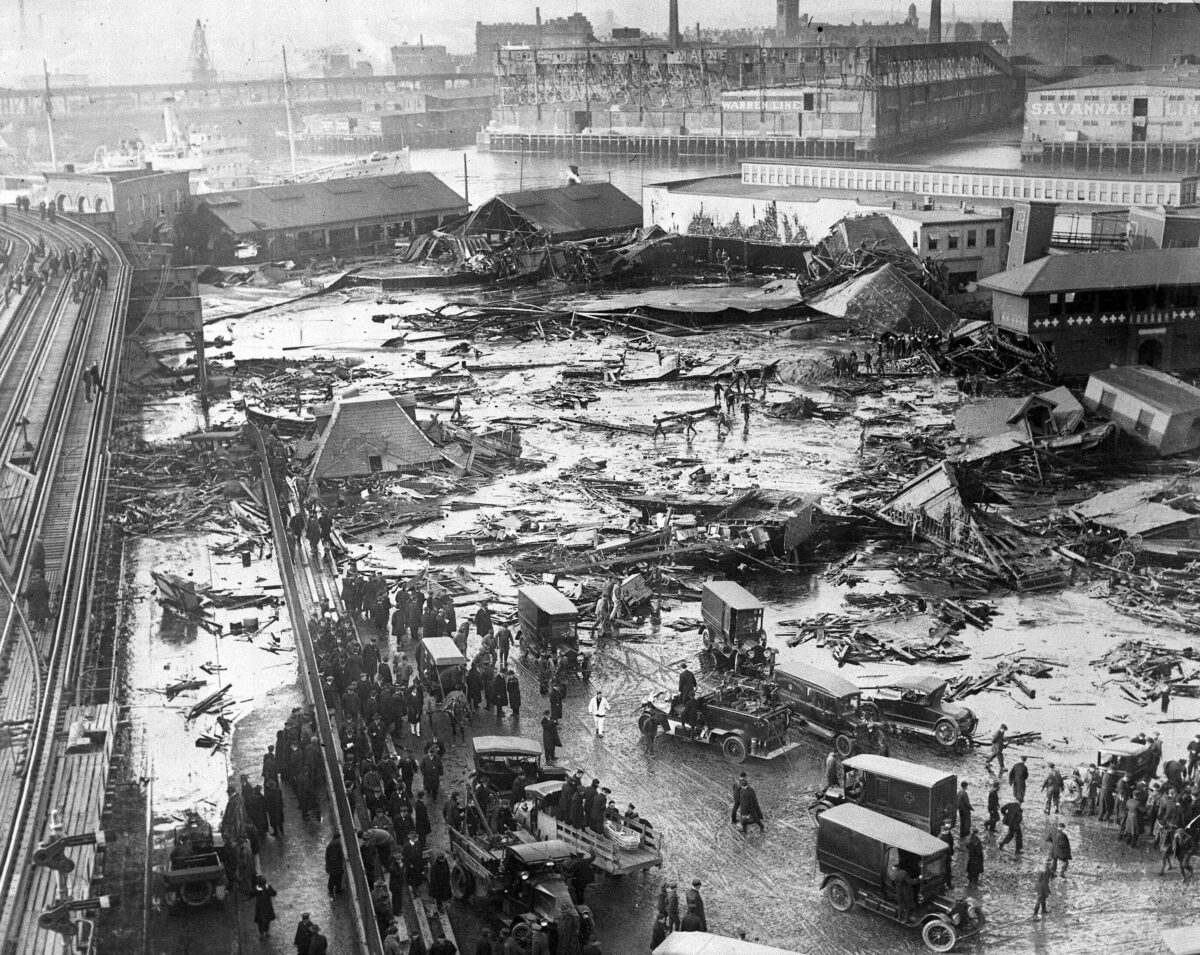
On January 15, 1919, a 50-foot tall tank of molasses exploded in Boston’s North End. What happened next sounds like something out of a movie, but it was terrifyingly real.
If you’ve ever walked through Boston’s North End, you’ve probably noticed the narrow streets, the old brick buildings, and the smell of fresh cannoli drifting from bakery windows. It’s one of the most charming neighborhoods in America.
But over 100 years ago, this same neighborhood was the site of one of the weirdest industrial disasters in history. A massive wave of molasses (yes, the thick, sticky stuff you put in gingerbread cookies), tore through these streets at 35 miles per hour. It killed 21 people, injured 150 more, and left a mess that took weeks to clean up.
This is the story of the Great Molasses Flood. And trust me, it’s stranger than you think.
Before we get to the flood, let’s set the scene.
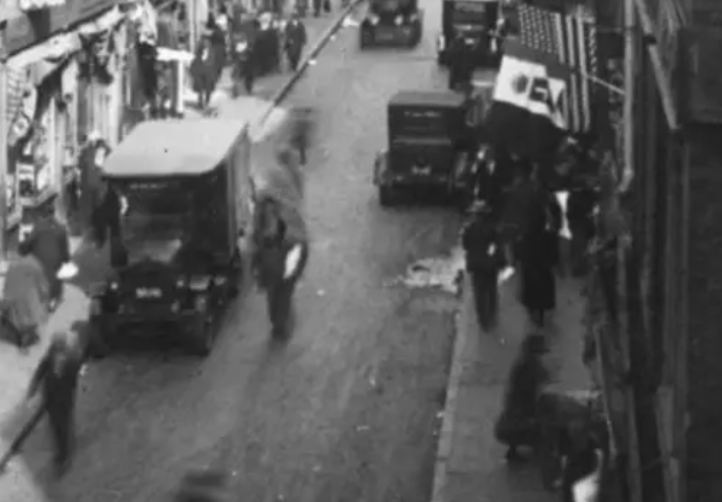
In 1919, Boston’s North End looked very different than it does today. Sure, Italian restaurants and bakeries were starting to pop up. But this was also a working-class neighborhood packed with immigrants, mostly Italian and Irish families, living in cramped tenement apartments.
The streets buzzed with activity. Kids played on the sidewalks. Workers headed to the factories and warehouses that lined the waterfront. Horse-drawn carts rattled over cobblestones.
And looming over it all? A giant steel tank, five stories tall and 90 feet wide, filled to the brim with 2.3 million gallons of molasses.
The tank belonged to the Purity Distilling Company, located at 529 Commercial Street near Copps Hill Wharf. They used molasses to make industrial alcohol, the kind used in munitions during World War I. The tank sat right next to a busy street, the Engine 31 fire station, and the Boston Elevated Railway. Hundreds of people passed by it every single day.
Here’s the thing: that tank was a disaster waiting to happen. And plenty of people knew it.
The Purity Distilling Company’s molasses tank had problems from day one.
When it was built in 1915, workers rushed to finish it. The company was eager to start production, so they cut corners. The steel walls were too thin, a 2014 engineering analysis found they were only half as thick as they should have been, even by 1915 standards. The steel also lacked manganese, making it brittle and prone to cracking. There weren’t enough rivets holding it together. Nobody even tested it with water before filling it with molasses.
Almost immediately, the tank started leaking.
Brown streaks of molasses oozed down the sides. The smell of the sweet, sticky liquid hung in the air. Local kids would actually bring cups and pails to collect the dripping molasses – free treats from a faulty tank.
Residents complained. They told the company the tank was dangerous. The company’s response? They painted the tank brown so the leaks wouldn’t be as visible.
Not exactly a fix.
The tank’s manager, Arthur Jell, had no engineering background. He couldn’t even read blueprints. When workers reported strange groaning sounds coming from the tank, he ignored them. When a laborer brought actual shards of cracked steel from the tank’s walls into Jell’s office as evidence of danger, the treasurer reportedly replied, “I don’t know what you want me to do. The tank still stands.”
Just two days before the disaster, a ship called the Miliero arrived from Cuba carrying a fresh load of warm molasses. Workers pumped this warm molasses into the tank, mixing it with the cold molasses already inside. This temperature difference caused the molasses to ferment and expand, building pressure inside an already dangerously weak structure.
On January 15, 1919, those warning groans turned into a roar.
January 15, 1919 started out as a surprisingly warm winter day. Temperatures had jumped from below freezing to around 40 degrees. The sun was shining. People were out and about, enjoying the mild weather.
At around 12:30 in the afternoon, city workers were eating lunch near the tank. A group of firefighters played cards in the Engine 31 fire station. Kids were out of school, some collecting firewood, others playing in the streets. At his family’s home overlooking the tank, a barman named Martin Clougherty was still dozing after a late shift at his saloon.
Then came the sound.
Witnesses described it as a deep rumble, like a machine gun firing or a freight train roaring past. The ground shook. The rivets holding the tank together shot out like bullets, pinging off buildings and embedding in brick walls.
And then 2.3 million gallons of molasses exploded into the streets.
Picture this: a wall of thick, brown molasses, two to three stories tall, moving faster than you can run.
The wave reached speeds of 35 miles per hour – about as fast as a car driving through a neighborhood. Accounts vary on the exact height, with reports ranging from 15 to 40 feet depending on location. The official plaque at the disaster site describes a “40-foot wave.” What’s certain is that it was tall enough to buckle the steel supports of the elevated railway and crush buildings like cardboard.
But this wasn’t water. Molasses is heavy, about 1.5 times denser than water. And in January, even on a warm day, it was cold enough to be incredibly dense.
The force was unbelievable.
The Boston Globe reported that buildings “cringed up as though they were made of pasteboard.” The wave ripped structures off their foundations. It crumpled the steel supports of the Boston Elevated Railway like they were made of paper. It picked up trucks, carts, and horses and tossed them around like toys. One truck was hurled all the way into Boston Harbor.
The Engine 31 firehouse was knocked clean off its foundation, its second story collapsing into its first. The firefighters who had been playing cards just moments before were suddenly trapped in a molasses-flooded pocket of space, fighting for their lives.
The Clougherty home was swept away and dashed against the elevated train platform. Martin Clougherty, having just woken up, watched his home crumble around him before being thrown into the current. “I was in bed on the third floor of my house when I heard a deep rumble,” he later remembered. “When I awoke, it was in several feet of molasses.” Martin nearly drowned in the gooey whirlpool before grabbing onto something floating nearby, his own bed frame. He used it as a makeshift raft to rescue his sister Teresa. But his mother and younger brother were among those killed.
The Boston Post described the aftermath: “Here and there struggled a form, whether it was animal or human being was impossible to tell. Only an upheaval, a thrashing about in the sticky mass, showed where any life was.” Horses caught in the flood “died like so many flies on sticky fly paper.”
The chaos lasted only minutes. But for the people caught in it, those minutes felt like hours.
Here’s a question people ask all the time: if you got caught in the wave, couldn’t you just swim out?
The answer is no, and the science explains why this flood was so deadly.
Molasses is what scientists call a “non-Newtonian fluid.” That means the faster you try to move through it, the thicker it becomes. Imagine trying to swim through concrete that keeps getting harder the more you struggle.
A 2013 Scientific American article explained it this way: “A wave of molasses does not behave like a wave of water… A wave of molasses is even more devastating than a typical tsunami. In 1919 the dense wall of syrup surging from its collapsed tank initially moved fast enough to sweep people up and demolish buildings, only to settle into a more gelatinous state that kept people trapped.”
When the wave hit, victims were knocked down by the sheer force. Then the molasses pinned them in place. Every attempt to move just made the liquid resist more. Arms and legs got stuck. Heads got pushed under. The more people fought, the more trapped they became.
The cold January air made things worse. As the temperature dropped, the molasses thickened even further. What started as a flowing liquid became closer to thick tar within minutes.
Rescue workers later described pulling victims from the molasses like pulling them from quicksand. Many survivors had to be cut out of their clothes, which had hardened into a sticky shell around their bodies.
There are harrowing stories of survival, like that of a young boy who was picked up by the wave and carried like a surfer on a syrupy crest until he was finally rescued, barely able to breathe because his throat was clogged with molasses.
It’s a terrifying thought: a flood you literally cannot swim through. And it helps explain why 21 people lost their lives in what sounds like it should have been a survivable situation.
When the wave finally stopped, the North End looked like a war zone.
Buildings were destroyed. Wreckage was everywhere. And covering it all was a layer of thick, brown molasses, some spots were waist-deep. The streets were flooded two to three feet deep in places.
Rescue workers rushed to the scene within minutes. Police and firefighters arrived first, followed quickly by 116 cadets from the Navy training ship USS Nantucket, which was docked nearby. These young sailors waded into knee-deep molasses to pull out survivors. Red Cross nurses, Army soldiers, and regular citizens all pitched in.
But the molasses made everything harder.
The sticky liquid clung to everything. It pulled at boots. It coated ropes and tools. It made it almost impossible to move quickly. Victims trapped under debris were slowly being suffocated by the thickening goo. One Boston Post reporter wrote: “If a worker stood still for a minute he found himself glued to the ground.”
The cold didn’t help. As temperatures dropped, the molasses became even thicker and harder to work with. Rescuers used chisels and saws to cut through the hardening mess.
The most dramatic rescue took place at the Engine 31 firehouse, where several firefighters from the lunchtime card game were trapped in a molasses-flooded pocket of space on the collapsed first floor. Workers freed the survivors after several hours of cutting away floorboards and debris, but not before one of the firefighters lost his strength and drowned.
Over 100 rescue workers searched through the night, using lanterns to spot survivors in the darkness. A makeshift outdoor hospital was set up to treat the injured. They found bodies in strange places – under collapsed buildings, inside wrecked train cars, even floating in the harbor where the molasses had flowed.
The final toll:
The short answer? Weeks of backbreaking work. But the sticky truth is more complicated.
The initial rescue and recovery took about four days. Workers searched through the wreckage around the clock, pulling out survivors and, eventually, bodies. The last direct victim wasn’t found until nearly four months later, 32-year-old Cesare Nicolo was discovered under a wharf near Commercial Street during a spring cleanup.
The major cleanup effort lasted about two weeks. Over 300 workers descended on the North End armed with shovels, brooms, and fire hoses. They pumped thousands of gallons of salt water from the harbor to dissolve the molasses. Fresh water would have just made it stickier – salt water was the key. The Engine 31 fireboat, whose firehouse had been destroyed in the flood, was crucial in the cleanup efforts.
But getting the neighborhood truly clean? That took much longer.
Molasses had seeped into every crack and crevice. It coated basements, soaked into wooden floors, and clung to brick walls. Workers spread sand and sawdust on the streets to absorb the goo. They scrubbed buildings by hand with stiff brushes. The elevated railway had to be cleaned car by car.
For months, every person who walked through the North End tracked sticky brown footprints across Boston. Subway seats, telephone receivers, doorknobs, everything stayed tacky. As one famous remark put it: “Everything that a Bostonian touched was sticky.” The waters of Boston Harbor remained stained brown until the summer.
Cleaning up 2.3 million gallons of molasses was a job nobody ever wanted to do again.
After the disaster, people wanted answers. And more importantly, they wanted someone to take responsibility.
Over 125 lawsuits were filed against the United States Industrial Alcohol Company (USIA), the parent company of Purity Distilling. This was a big deal in 1919. Back then, companies rarely faced consequences for accidents like this. Most courts sided with businesses, not workers or residents.
But this case was different.
The cases were eventually combined into a massive legal proceeding. A court-appointed auditor named Hugh W. Ogden was assigned to investigate and oversee the case. For the next six years, he heard testimony from over 3,000 witnesses. Nearly 45,000 pages of testimony and arguments were recorded. There were so many lawyers involved that the courtroom couldn’t hold them all.
The company tried to blame the disaster on anarchists. They claimed someone had planted a bomb in the tank. It sounds crazy now, but this was 1919, the height of the first Red Scare. Anarchist bombings were a real concern (there had even been a bomb discovered at a USIA facility in Brooklyn in 1916), and the company spent over $50,000 on expert witness fees trying to prove sabotage.
It didn’t work.
Ogden’s investigation proved the tank was poorly built from the start. The steel was too thin. The rivets were spaced too far apart. The company had ignored warning signs for years. There was no bomb, just greed and negligence.
On April 28, 1925, Ogden released his report, rejecting USIA’s sabotage claims outright and concluding that the tank collapsed due to structural failure. The court ruled against USIA. The company ultimately paid out $628,000 in settlements – about $8 to $10 million in today’s money. Families of those killed reportedly received about $7,000 per victim, which was significant money in those days.
It was one of the first major cases where a corporation was held responsible for an industrial disaster, and it helped pave the way for modern corporate accountability laws.
The Great Molasses Flood didn’t just reshape Boston’s North End. It reshaped how America thinks about safety.
Before 1919, there weren’t many rules about how companies built things. Engineers didn’t need licenses. Buildings didn’t need inspections. Companies could cut corners without much fear of consequences.
The molasses disaster changed that.
New rules included:
Stephen Puleo, author of “Dark Tide: The Great Boston Molasses Flood of 1919,” views the disaster as a pivotal event that did for U.S. construction standards what the Cocoanut Grove fire later did for fire codes.
These changes didn’t happen overnight. But the molasses flood was a turning point. It showed what could happen when companies put profit over safety. And it proved that regular people could hold powerful corporations accountable.
Walk through the North End today and you’ll find one of the best food neighborhoods in America. Italian bakeries, family-owned restaurants, and some of the finest espresso on the East Coast.
But if you know where to look, you can still find traces of the molasses flood.
The tank once stood at 529 Commercial Street, near Copps Hill Wharf where molasses shipments were delivered. Today, that location is home to Langone Park and the Puopolo Athletic Field. A small plaque at the entrance to Puopolo Park, placed by the Bostonian Society, marks the spot where 21 people lost their lives over a century ago.
In 2016, researchers used ground-penetrating radar to identify the exact location of the tank. The concrete slab base remains in place approximately 20 inches below the surface of the baseball diamond at Langone Park. On January 15, 2019, the 100th anniversary of the disaster, attendees of a memorial ceremony stood in a circle marking the edge of the tank while the names of the 21 victims were read aloud.
Here’s the question I always get asked: can you still smell molasses in the North End?
The honest answer is… maybe?
For years after the flood, the smell was undeniable. Molasses had soaked into the wood, brick, and soil of the neighborhood. On hot summer days, the sweet, burnt-sugar scent would rise from the streets and buildings. According to journalist Edwards Park, “The smell of molasses remained for decades a distinctive, unmistakable atmosphere of Boston.”
Old-timers who grew up in the North End swear they could smell it well into the 1950s and beyond. Some surviving residents interviewed in the 1980s claimed that on very hot days, you could not only smell molasses but actually observe it seeping up through cracks in the sidewalk.
Is it actually molasses from 1919? Probably not. More likely it’s the power of suggestion mixed with the general smells of an old city neighborhood.
But here’s the thing: when you’re standing at 529 Commercial Street, where the tank once stood, and someone tells you to take a deep breath… you might just convince yourself you smell it too.
That’s part of what makes the North End special. The history isn’t just in the books. It’s in the streets, the buildings, and maybe, just maybe, still in the air.
When you take a food tour through the North End, you’re walking the same streets that were covered in molasses back in 1919. You’re passing buildings that survived the flood. You’re eating in a neighborhood that rebuilt itself after one of the strangest disasters in American history.
That’s what makes the North End special. It’s not just about the food – although the food is incredible. It’s about the stories. The history. The resilience of a community that has been through everything and keeps coming back stronger.
The Great Molasses Flood happened over 100 years ago. So why should we still care?
Because the lessons still apply.
Every time a company cuts corners to save money, they risk another disaster. Every time regulators look the other way, they put people in danger. The molasses flood reminds us that safety standards exist for a reason – and they exist because people died.
It’s also a reminder that communities can recover from almost anything. The North End in 1919 was devastated. Today, it’s one of the most beloved neighborhoods in Boston – and America. That didn’t happen by accident. It happened because people rebuilt, adapted, and refused to give up.
Want to see where the Great Molasses Flood happened? Want to taste the best cannoli, pizza, and pasta in Boston while learning the stories behind this historic neighborhood?
Book the North End Boston Food Tour and I’ll show you around. You’ll eat incredible food, hear amazing stories, and walk through 400 years of Boston history, one delicious bite at a time.
Because in the North End, every street has a story. And some of those stories are sweeter (and stickier) than you’d ever expect.
NORTH END BOSTON FOOD TOUR
Solo, Privates, Couples,
Groups, and Corporate tours.
617-719-9542
Meeting Location:
Tony DeMarco Statue,
191 Hanover St, Boston, MA 02113
Get the latest bites and insider tips. Sign up for our newsletter!
North End Boston Food Tours © 2025, All rights reserved.
HOME ABOUT US CONTACT US BOOK A TOUR MEET YOUR TOUR GUIDE LITTLE ITALY HISTORY PARTNERS GALLERY REVIEWS BLOG FAQS Powered by
Written by
Bobby Agrippino
Date
Jan 9, 2026
The North End is loud about its food (and rightfully so). Lines down Hanover Street. Neon signs. Pastry boxes stacked like Jenga towers. But if you want the version of the neighborhood that locals quietly protect, you end up a few blocks off the main drag on Prince Street, pushing open the door at Parziale’s Bakery.
No spectacle. No gimmicks. Just a bakery that’s been doing the same thing for more than a century and never felt the need to explain itself.
I grew up in this neighborhood and have lived here my entire life. The North End didn’t just shape my taste in food, it shaped how I understand community. Parziale’s is the kind of place that reminds me of that every time I walk in.
Parziale’s Bakery is located at 80 Prince Street, Boston, MA 02113, just off Salem Street in a quieter, mostly residential stretch of the North End.
That location is everything. Locals stop in for bread. Families grab pizza for dinner.
When I bring people here on the North End Boston Food Tour, they immediately feel the difference. This isn’t a stop designed for tourists. It’s a place that locals never stopped going to.
Calling it “hole-in-the-wall” isn’t dismissive; it’s a badge of honor. This bakery has authentic history baked into its bricks and served up with every loaf and cannoli. Compared to more tourist-heavy pastry counters, Parziale’s gives you something rare in a city full of classic sweets: a local secret with roots deeper than most.
Visitors often tell stories of finding Parziale’s by accident and instantly falling in love with the unpretentious vibe and classic flavors.
Parziale’s history is part of Boston’s food history.
Parziale’s story starts in 1907, when Joseph and Anna Parziale immigrated from the Sarno area near Naples and opened a bakery in the North End. Joseph built his own brick oven and began baking bread for the neighborhood.
Over time, Parziale’s is widely credited with introducing pizza to Boston, originally from a location on Charter Street before settling on Prince Street.
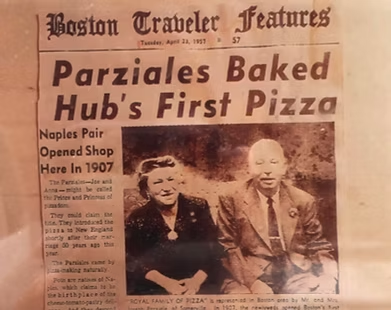
Today, the bakery is still run by the Parziale family, now in its fourth generation, using traditional methods and recipes that have remained largely unchanged for over a century.
That continuity is rare, and you can taste it.
While Parziale’s is known for its bread and pastries, the bakery has been leaning more heavily into pizza and calzones recently, and that shift has paid off.
If you only order one thing, start here.
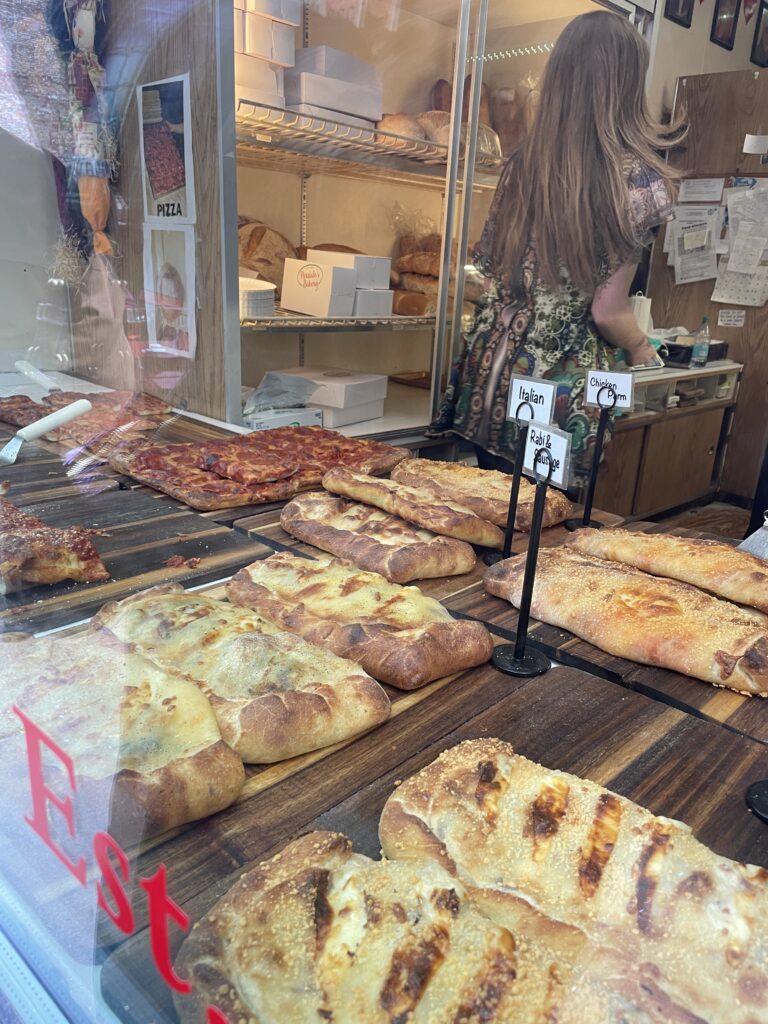
Parziale’s Sicilian pizza is classic square-cut, no-nonsense, and deeply satisfying. The crust is airy but sturdy, the sauce slightly sweet, and the slices are inexpensive compared to most North End options. It’s the kind of pizza locals grab without thinking twice.
The calzones deserve special attention. The sausage and broccoli rabe is a standout: savory sausage, bitter greens, and well-baked dough that holds everything together without feeling heavy. It’s balanced, filling, and quietly excellent.
Parziale’s desserts often rival the more famous bakeries nearby.
They also wholesale bread to local restaurants, so there’s a good chance you’ve already eaten Parziale’s without realizing it.
Parziale’s feels lived-in, not “curated.” There’s less foot traffic than at big tourist draws like Bova’s. That’s part of why locals love it. People come for breakfast pastries, swing back in for a midday slice, or grab bread for dinner. They’re welcomed like regulars even if it’s your first visit.
If you want the North End experience that feels like stepping into its history rather than a tourist stop, start your exploration at Parziale’s. It’s not just a bakery. It’s a quiet reminder that some of the best food in Boston is about family traditions that survive the centuries.
Open early and often, it’s exactly the kind of authentic, hole-in-the-wall spot worth seeking out on your next Boston adventure.
NORTH END BOSTON FOOD TOUR
Solo, Privates, Couples,
Groups, and Corporate tours.
617-719-9542
Meeting Location:
Tony DeMarco Statue,
191 Hanover St, Boston, MA 02113
Get the latest bites and insider tips. Sign up for our newsletter!
North End Boston Food Tours © 2025, All rights reserved.
HOME ABOUT US CONTACT US BOOK A TOUR MEET YOUR TOUR GUIDE LITTLE ITALY HISTORY PARTNERS GALLERY REVIEWS BLOG FAQS Powered by
Menu
Written by
Bobby Agrippino
Date
Dec 31, 2025
I’ve lived my entire life in Boston’s North End. This neighborhood didn’t just shape me, it raised me. Every street, every doorway, every bakery window holds a memory tied to my family, my childhood, and the people who made this place what it is.
When I walk through the North End, I don’t see it like a visitor does. I see generations. I see tradition. I see a tight-knit Italian neighborhood that taught me what community really means.
My name is Bobby Agrippino, and this North End Boston Food Tour isn’t something I created to show tourists where to eat. It’s my story, my culture, and my roots, shared through the food and history of the neighborhood I’ve always called home.
Growing up in the North End felt like growing up inside one big family. You didn’t just know your neighbors. You knew their parents, their grandparents, what they cooked on Sundays, and which bakery they swore by.
Food was at the center of everything. It wasn’t about going out to eat. It was homemade sauce simmering all day, fresh bread pulled straight from the oven, and family recipes passed down without ever being written down.
To this day, my mom still makes the best eggplant parm I’ve ever had. No restaurant version comes close. That dish alone explains more about North End Italian cooking than any guidebook ever could. It’s made the way it always has been, with patience, pride, and love, and that’s the same spirit behind this tour.
Those are the things that stay with you forever.
I didn’t set out to become a tour guide. I started this tour because I wanted people to feel the North End the way I do.
Too often, I’d see visitors rush through the neighborhood, grab a quick slice, snap a few photos, and leave without ever understanding what makes this place special. The North End isn’t just restaurants and historic buildings. It’s family. It’s sacrifice. It’s generations of people protecting their culture and passing it down.
This food tour was my way of offering something different. An authentic Boston food experience led by someone who grew up living these stories, not reading them off a script.
When you join my North End Boston food tour, you’re not following a flag or listening to rehearsed lines. You’re walking the neighborhood with someone whose life is deeply connected to it.
I take you to the places I grew up with.
I share the stories I lived, not just the ones in history books.
And sometimes, we even run into my mom, because that’s how real this neighborhood is.
You can’t manufacture that. You can’t fake it. That’s what makes this one of the most authentic food tours in Boston.
I believe food brings people together, but stories are what make people stay.
This North End food tour is about more than great Italian food. It’s about understanding the neighborhood, the people, and the culture that made it legendary. I want you to leave feeling like you didn’t just visit Boston, you experienced it through a local’s eyes.
This tour is personal. It’s emotional. It’s real. And if you decide to walk these streets with me, you’ll feel that from the very first stop.
If you want more than a quick bite and a few photos, this tour is for you. The North End Boston Food Tour is a chance to experience real Italian food, real stories, and the neighborhood the way locals have for generations.
Spots are limited to keep the experience personal, and tours fill up fast.
Book your North End Boston Food Tour now and walk the neighborhood with someone who grew up here.
Prefer to plan ahead or give the experience as a gift?
Gift cards are available year-round.
NORTH END BOSTON FOOD TOUR
Solo, Privates, Couples,
Groups, and Corporate tours.
617-719-9542
Meeting Location:
Tony DeMarco Statue,
191 Hanover St, Boston, MA 02113
PRIVACY POLICY
•
ACCESSIBILITY
Facebook
Instagram
Tiktok
Youtube
X-twitter
Linkedin
Pinterest
Get the latest bites and insider tips. Sign up for our newsletter!
North End Boston Food Tours © 2025, All rights reserved.
HOME
ABOUT US
CONTACT US
BOOK A TOUR
MEET YOUR TOUR GUIDE
LITTLE ITALY HISTORY
PARTNERS
GALLERY
REVIEWS
BLOG
FAQS
Powered by
Written by
Bobby Agrippino
Date
Nov 19, 2025
If you’ve only got one day here, you deserve an itinerary shaped by someone who actually lives in the city and knows where the real stories, food, and culture are. Boston is my home. I grew up in the North End, Boston’s oldest neighborhood, surrounded by the kind of community you don’t find in many cities anymore. When people ask how to spend a single day in Boston, I share the version locals would choose, not the one-size-fits-all list you see on travel sites.
This guide gives you a full, meaningful Boston day: history in the morning, food and culture in the afternoon, and a perfect night out. The centerpiece, of course, is my North End Boston Food Tour, which gives you the real insider experience you can’t find anywhere else.
If you’re trying to figure out what the top things to do in Boston are for a single day, here’s the short answer: mix history, food, and real neighborhood culture. This itinerary focuses on the experiences visitors talk about long after they’ve flown home.
The Freedom Trail winds through 16 historic sites, but you don’t need to check every one off the list. Start at Boston Common and follow the red line toward downtown. You’ll pass spots like the Granary Burying Ground, the Old State House, and Faneuil Hall.
This is the quickest way to absorb Boston’s Revolutionary spirit without spending your whole morning indoors or rushing through museums. Take your time, look up at the architecture, and let the city set the tone for your day.
If you want one immersive, theatrical, hands-on attraction, this is it. The museum lets you step directly into the events that sparked the American Revolution. You can even throw tea overboard like the Sons of Liberty did in 1773.
It’s interactive, quick, and memorable, and it sets you up perfectly for an afternoon in the North End.
Whether you join the 11:30 AM or 2:30 PM tour, the timing fits seamlessly into a one-day Boston itinerary. Do not eat a full lunch before this. The tour includes generous portions from some of the neighborhood’s most iconic family-owned shops and restaurants.
And this isn’t a typical food tour where you get two raviolis and need to pay separately for your wine (You’re a guest in my neighborhood, everything is all-inclusive). Every stop tells a story, every dish has heritage behind it, and every corner of the North End holds a memory.
On the tour, you’ll:
• Eat authentic dishes from the same spots locals have loved for decades
• Learn the real history of the neighborhood from someone who’s lived it
• Explore the North End the way lifelong residents experience it, not the way guidebooks describe it
Most guests tell me this tour becomes the part of their Boston visit they talk about long after they’ve gone home. It’s food, culture, neighborhood, and history all in one experience.
Did you know you can give a tour to someone else? Follow this link to share it with a loved one.
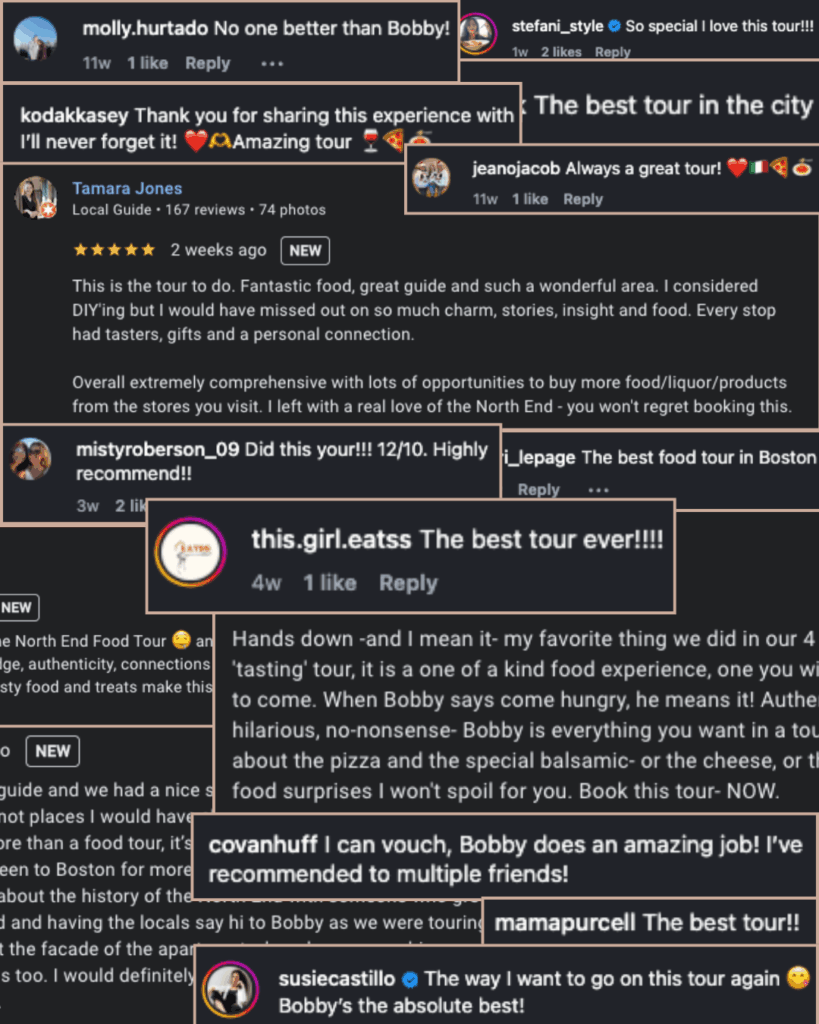
Depending on which tour time you choose, you’ll have options for how to spend your remaining hours.
You’ll finish with a full stomach and the pulse of local history in your ears. Choose one of these two nearby cultural gems:
A world-class museum that holds everything from ancient artifacts to contemporary masterpieces. You can spend an hour here or get lost for the rest of the day.
Or
Institute of Contemporary Art
The ICA showcases cutting-edge contemporary art with stunning waterfront views and bold exhibitions you won’t find anywhere else in Boston. It’s the perfect spot to explore new ideas, discover emerging artists, and enjoy a vibrant creative experience after your tour.
This is one of the most beautiful public libraries in the country. Marble staircases, murals, quiet courtyards, and architecture that surprises every visitor.
You’ll finish in the early evening, right when the North End starts to glow. Wander through the neighborhood, take photos, stop into a shop or two, and savor the atmosphere. The streets feel different at night: lively, warm, and unmistakably Boston.
Boston offers a strong finish to the day no matter the season.
You’re right on the doorstep of the arena.
Musicals, comedy, local productions, national tours.
On a warm night, the harbor is peaceful, beautiful, and just a short ride from the North End.
If you want to swap in or extend your day, consider:
• Boston Common + Public Garden for a scenic, easy stroll
• New England Aquarium if you’re traveling with kids
• Harvard Square for a quick Cambridge adventure
You can spend months exploring Boston and still uncover something new. But if you only have one day, the best way to understand the city is to combine its history with its living culture. That’s why the North End sits at the center of this guide.
The neighborhood isn’t just where I live. It’s where my family’s roots are, where generations of stories are baked into every brick, and where visitors can feel the real spirit of Boston in a way no other neighborhood offers.
If you want your one day in Boston to be memorable, meaningful, and delicious, I’d love to show you my home on the North End Boston Food Tour.
Discover hidden gems, family-owned bakeries, legendary salumerias, and centuries of Italian history with authentic insider access. Taste, explore, and learn your way through Boston’s Little Italy on the tour everyone is talking about.
NORTH END BOSTON FOOD TOUR
Solo, Privates, Couples,
Groups, and Corporate tours.
617-719-9542
Meeting Location:
Tony DeMarco Statue,
191 Hanover St, Boston, MA 02113
Get the latest bites and insider tips. Sign up for our newsletter!
North End Boston Food Tours © 2025, All rights reserved.
HOME ABOUT US CONTACT US BOOK A TOUR MEET YOUR TOUR GUIDE LITTLE ITALY HISTORY PARTNERS GALLERY REVIEWS BLOG FAQS Powered by