The North End Wasn’t Always Italian, Here’s How It Became Boston’s Proudest Neighborhood
Written by
Bobby Agrippino
Date
Feb 23, 2026
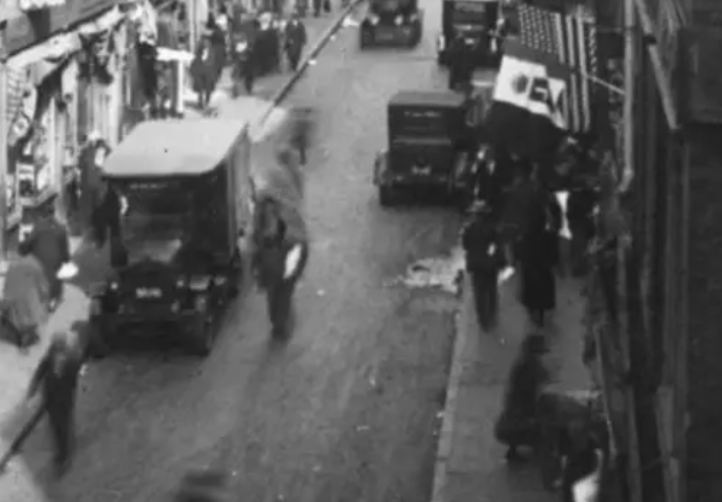
Walk down Hanover Street today and you’ll see pastry shops, trattorias, espresso bars, and tourists snapping photos of every corner. The North End feels like it’s always been this way, a proud, thriving Italian neighborhood at the heart of Boston.
But a hundred years ago, these same streets told a very different story. This was a neighborhood fighting to survive. And the people who lived here were fighting just to belong.
“No Italians”
The Italian immigrants who settled in the North End in the early 1900s didn’t speak English. They weren’t considered fully American. Many worked the lowest-paying jobs the city had to offer, digging tunnels, hauling freight, laying bricks.
Signs in shop windows and boarding houses read “No Italians.” Newspapers ran cartoons depicting them as criminals. The message was clear: you are not welcome here.
And then something happened right here in Massachusetts that shook every Italian neighborhood in America.
The Trial That Changed Everything
In 1920, two Italian immigrants, Nicola Sacco and Bartolomeo Vanzetti, were arrested for armed robbery and murder in Braintree, Massachusetts. The evidence was thin. The trial was riddled with bias. The judge openly referred to them as “anarchist bastards.”
They were convicted. Appeals were denied. And on August 23, 1927, both men were executed.
To Italians in the North End, the Sacco and Vanzetti case wasn’t just a trial. It was a message from the country they’d come to call home: You don’t belong.
Protests erupted across the world, from London to Buenos Aires. But in the Italian neighborhoods of Boston and New York, something deeper was happening. The grief was turning into resolve.
The Man Who Said “Don’t Hide — Vote”
In New York, a man named Generoso Pope Sr. was watching all of this unfold. Pope owned Il Progresso Italo-Americano, the largest Italian-language newspaper in the United States, with a readership that stretched from Manhattan to Boston to Chicago.
What Pope told his readers wasn’t “keep your head down.”
He told them: Become citizens. Register to vote. Build influence. Be proud of who you are.
Pope used his newspaper to rally Italian immigrants toward civic participation. He endorsed candidates, organized voter drives, and pushed the message that political power was the path to respect. He became one of the most influential Italian Americans in the country, advising mayors, governors, and even presidents.
That mindset, organize, show up, demand a seat at the table, spread to every Italian enclave in America. Including the streets right here in the North End.
From Invisible to Unstoppable
By the time the next generation came up, the children and grandchildren of those first immigrants, Italians in Boston weren’t hiding anymore.
The feasts got bigger. The Saint’s Day processions got louder. The smell of Sunday sauce drifted out of every triple-decker in the neighborhood.
And the politicians? They stopped ignoring the North End. They started showing up, shaking hands, and asking for votes.
Italian Americans weren’t outsiders anymore. They were police officers. Firefighters. Union leaders. Business owners. City councilors. And yes, eventually, even Presidents of the United States.
Every Cannoli Has a Story
This is what makes the North End more than a food destination. Every restaurant, every bakery, every festival on these streets exists because a community refused to disappear.
When you bite into a cannoli on Hanover Street, you’re not just tasting dessert. You’re tasting a neighborhood that fought, for generations, to be seen, to be heard, and to be proud.
Want to hear stories like this in person? The North End Food & History Tour takes you through the streets, the food, and the real history behind Boston’s most famous neighborhood. Book your tour today!
NORTH END BOSTON FOOD TOUR
Solo, Privates, Couples,
Groups, and Corporate tours.
617-719-9542
Meeting Location:
Tony DeMarco Statue,
191 Hanover St, Boston, MA 02113
The Great Molasses Flood: Boston’s Strangest (and Stickiest) Disaster
Written by
Bobby Agrippino
Date
Jan 15, 2026
On January 15, 1919, a 50-foot tall tank of molasses exploded in Boston’s North End. What happened next sounds like something out of a movie, but it was terrifyingly real.
If you’ve ever walked through Boston’s North End, you’ve probably noticed the narrow streets, the old brick buildings, and the smell of fresh cannoli drifting from bakery windows. It’s one of the most charming neighborhoods in America.
But over 100 years ago, this same neighborhood was the site of one of the weirdest industrial disasters in history. A massive wave of molasses (yes, the thick, sticky stuff you put in gingerbread cookies), tore through these streets at 35 miles per hour. It killed 21 people, injured 150 more, and left a mess that took weeks to clean up.
This is the story of the Great Molasses Flood. And trust me, it’s stranger than you think.
What Was the North End Like in 1919?
Before we get to the flood, let’s set the scene.
In 1919, Boston’s North End looked very different than it does today. Sure, Italian restaurants and bakeries were starting to pop up. But this was also a working-class neighborhood packed with immigrants, mostly Italian and Irish families, living in cramped tenement apartments.
The streets buzzed with activity. Kids played on the sidewalks. Workers headed to the factories and warehouses that lined the waterfront. Horse-drawn carts rattled over cobblestones.
And looming over it all? A giant steel tank, five stories tall and 90 feet wide, filled to the brim with 2.3 million gallons of molasses.
The tank belonged to the Purity Distilling Company, located at 529 Commercial Street near Copps Hill Wharf. They used molasses to make industrial alcohol, the kind used in munitions during World War I. The tank sat right next to a busy street, the Engine 31 fire station, and the Boston Elevated Railway. Hundreds of people passed by it every single day.
Here’s the thing: that tank was a disaster waiting to happen. And plenty of people knew it.
Warning Signs Everyone Ignored
The Purity Distilling Company’s molasses tank had problems from day one.
When it was built in 1915, workers rushed to finish it. The company was eager to start production, so they cut corners. The steel walls were too thin, a 2014 engineering analysis found they were only half as thick as they should have been, even by 1915 standards. The steel also lacked manganese, making it brittle and prone to cracking. There weren’t enough rivets holding it together. Nobody even tested it with water before filling it with molasses.
Almost immediately, the tank started leaking.
Brown streaks of molasses oozed down the sides. The smell of the sweet, sticky liquid hung in the air. Local kids would actually bring cups and pails to collect the dripping molasses – free treats from a faulty tank.
Residents complained. They told the company the tank was dangerous. The company’s response? They painted the tank brown so the leaks wouldn’t be as visible.
Not exactly a fix.
The tank’s manager, Arthur Jell, had no engineering background. He couldn’t even read blueprints. When workers reported strange groaning sounds coming from the tank, he ignored them. When a laborer brought actual shards of cracked steel from the tank’s walls into Jell’s office as evidence of danger, the treasurer reportedly replied, “I don’t know what you want me to do. The tank still stands.”
Just two days before the disaster, a ship called the Miliero arrived from Cuba carrying a fresh load of warm molasses. Workers pumped this warm molasses into the tank, mixing it with the cold molasses already inside. This temperature difference caused the molasses to ferment and expand, building pressure inside an already dangerously weak structure.
On January 15, 1919, those warning groans turned into a roar.
The Day Everything Went Wrong
January 15, 1919 started out as a surprisingly warm winter day. Temperatures had jumped from below freezing to around 40 degrees. The sun was shining. People were out and about, enjoying the mild weather.
At around 12:30 in the afternoon, city workers were eating lunch near the tank. A group of firefighters played cards in the Engine 31 fire station. Kids were out of school, some collecting firewood, others playing in the streets. At his family’s home overlooking the tank, a barman named Martin Clougherty was still dozing after a late shift at his saloon.
Then came the sound.
Witnesses described it as a deep rumble, like a machine gun firing or a freight train roaring past. The ground shook. The rivets holding the tank together shot out like bullets, pinging off buildings and embedding in brick walls.
And then 2.3 million gallons of molasses exploded into the streets.
A 25 to 40-Foot Wave of Sticky Death
Picture this: a wall of thick, brown molasses, two to three stories tall, moving faster than you can run.
The wave reached speeds of 35 miles per hour – about as fast as a car driving through a neighborhood. Accounts vary on the exact height, with reports ranging from 15 to 40 feet depending on location. The official plaque at the disaster site describes a “40-foot wave.” What’s certain is that it was tall enough to buckle the steel supports of the elevated railway and crush buildings like cardboard.
But this wasn’t water. Molasses is heavy, about 1.5 times denser than water. And in January, even on a warm day, it was cold enough to be incredibly dense.
The force was unbelievable.
The Boston Globe reported that buildings “cringed up as though they were made of pasteboard.” The wave ripped structures off their foundations. It crumpled the steel supports of the Boston Elevated Railway like they were made of paper. It picked up trucks, carts, and horses and tossed them around like toys. One truck was hurled all the way into Boston Harbor.
The Engine 31 firehouse was knocked clean off its foundation, its second story collapsing into its first. The firefighters who had been playing cards just moments before were suddenly trapped in a molasses-flooded pocket of space, fighting for their lives.
The Clougherty home was swept away and dashed against the elevated train platform. Martin Clougherty, having just woken up, watched his home crumble around him before being thrown into the current. “I was in bed on the third floor of my house when I heard a deep rumble,” he later remembered. “When I awoke, it was in several feet of molasses.” Martin nearly drowned in the gooey whirlpool before grabbing onto something floating nearby, his own bed frame. He used it as a makeshift raft to rescue his sister Teresa. But his mother and younger brother were among those killed.
The Boston Post described the aftermath: “Here and there struggled a form, whether it was animal or human being was impossible to tell. Only an upheaval, a thrashing about in the sticky mass, showed where any life was.” Horses caught in the flood “died like so many flies on sticky fly paper.”
The chaos lasted only minutes. But for the people caught in it, those minutes felt like hours.
Could You Swim in Molasses?
Here’s a question people ask all the time: if you got caught in the wave, couldn’t you just swim out?
The answer is no, and the science explains why this flood was so deadly.
Molasses is what scientists call a “non-Newtonian fluid.” That means the faster you try to move through it, the thicker it becomes. Imagine trying to swim through concrete that keeps getting harder the more you struggle.
A 2013 Scientific American article explained it this way: “A wave of molasses does not behave like a wave of water… A wave of molasses is even more devastating than a typical tsunami. In 1919 the dense wall of syrup surging from its collapsed tank initially moved fast enough to sweep people up and demolish buildings, only to settle into a more gelatinous state that kept people trapped.”
When the wave hit, victims were knocked down by the sheer force. Then the molasses pinned them in place. Every attempt to move just made the liquid resist more. Arms and legs got stuck. Heads got pushed under. The more people fought, the more trapped they became.
The cold January air made things worse. As the temperature dropped, the molasses thickened even further. What started as a flowing liquid became closer to thick tar within minutes.
Rescue workers later described pulling victims from the molasses like pulling them from quicksand. Many survivors had to be cut out of their clothes, which had hardened into a sticky shell around their bodies.
There are harrowing stories of survival, like that of a young boy who was picked up by the wave and carried like a surfer on a syrupy crest until he was finally rescued, barely able to breathe because his throat was clogged with molasses.
It’s a terrifying thought: a flood you literally cannot swim through. And it helps explain why 21 people lost their lives in what sounds like it should have been a survivable situation.
The Nightmare of Rescue and Cleanup
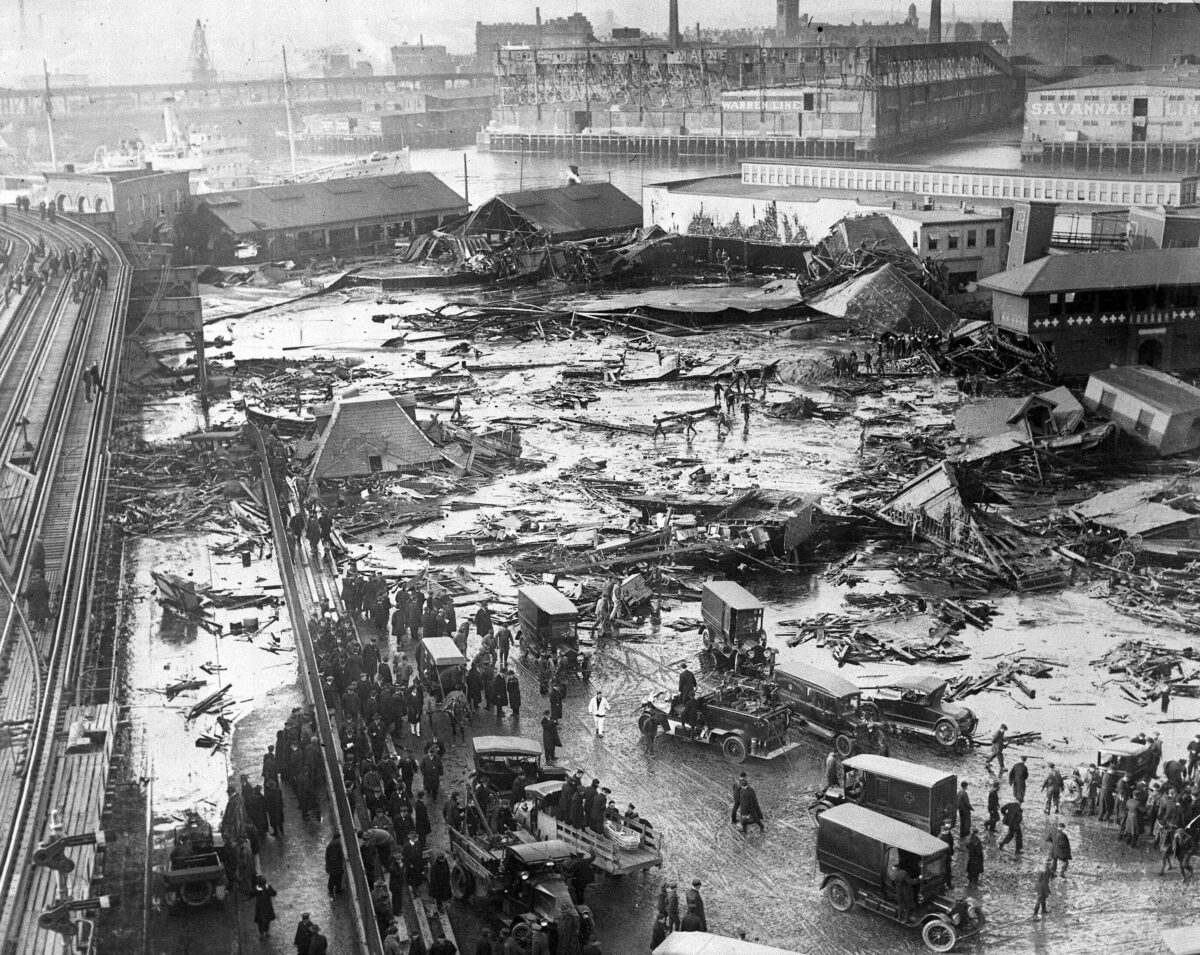
When the wave finally stopped, the North End looked like a war zone.
Buildings were destroyed. Wreckage was everywhere. And covering it all was a layer of thick, brown molasses, some spots were waist-deep. The streets were flooded two to three feet deep in places.
Rescue workers rushed to the scene within minutes. Police and firefighters arrived first, followed quickly by 116 cadets from the Navy training ship USS Nantucket, which was docked nearby. These young sailors waded into knee-deep molasses to pull out survivors. Red Cross nurses, Army soldiers, and regular citizens all pitched in.
But the molasses made everything harder.
The sticky liquid clung to everything. It pulled at boots. It coated ropes and tools. It made it almost impossible to move quickly. Victims trapped under debris were slowly being suffocated by the thickening goo. One Boston Post reporter wrote: “If a worker stood still for a minute he found himself glued to the ground.”
The cold didn’t help. As temperatures dropped, the molasses became even thicker and harder to work with. Rescuers used chisels and saws to cut through the hardening mess.
The most dramatic rescue took place at the Engine 31 firehouse, where several firefighters from the lunchtime card game were trapped in a molasses-flooded pocket of space on the collapsed first floor. Workers freed the survivors after several hours of cutting away floorboards and debris, but not before one of the firefighters lost his strength and drowned.
Over 100 rescue workers searched through the night, using lanterns to spot survivors in the darkness. A makeshift outdoor hospital was set up to treat the injured. They found bodies in strange places – under collapsed buildings, inside wrecked train cars, even floating in the harbor where the molasses had flowed.
The final toll:
21 people dead
150 injured
Dozens of horses killed
Several buildings completely destroyed
Property damage totaling nearly $100 million in today’s dollars
How Long Did It Take to Clean Up the Molasses Flood?
The short answer? Weeks of backbreaking work. But the sticky truth is more complicated.
The initial rescue and recovery took about four days. Workers searched through the wreckage around the clock, pulling out survivors and, eventually, bodies. The last direct victim wasn’t found until nearly four months later, 32-year-old Cesare Nicolo was discovered under a wharf near Commercial Street during a spring cleanup.
The major cleanup effort lasted about two weeks. Over 300 workers descended on the North End armed with shovels, brooms, and fire hoses. They pumped thousands of gallons of salt water from the harbor to dissolve the molasses. Fresh water would have just made it stickier – salt water was the key. The Engine 31 fireboat, whose firehouse had been destroyed in the flood, was crucial in the cleanup efforts.
But getting the neighborhood truly clean? That took much longer.
Molasses had seeped into every crack and crevice. It coated basements, soaked into wooden floors, and clung to brick walls. Workers spread sand and sawdust on the streets to absorb the goo. They scrubbed buildings by hand with stiff brushes. The elevated railway had to be cleaned car by car.
For months, every person who walked through the North End tracked sticky brown footprints across Boston. Subway seats, telephone receivers, doorknobs, everything stayed tacky. As one famous remark put it: “Everything that a Bostonian touched was sticky.” The waters of Boston Harbor remained stained brown until the summer.
Cleaning up 2.3 million gallons of molasses was a job nobody ever wanted to do again.
Who Was to Blame?
After the disaster, people wanted answers. And more importantly, they wanted someone to take responsibility.
Over 125 lawsuits were filed against the United States Industrial Alcohol Company (USIA), the parent company of Purity Distilling. This was a big deal in 1919. Back then, companies rarely faced consequences for accidents like this. Most courts sided with businesses, not workers or residents.
But this case was different.
The cases were eventually combined into a massive legal proceeding. A court-appointed auditor named Hugh W. Ogden was assigned to investigate and oversee the case. For the next six years, he heard testimony from over 3,000 witnesses. Nearly 45,000 pages of testimony and arguments were recorded. There were so many lawyers involved that the courtroom couldn’t hold them all.
The company tried to blame the disaster on anarchists. They claimed someone had planted a bomb in the tank. It sounds crazy now, but this was 1919, the height of the first Red Scare. Anarchist bombings were a real concern (there had even been a bomb discovered at a USIA facility in Brooklyn in 1916), and the company spent over $50,000 on expert witness fees trying to prove sabotage.
It didn’t work.
Ogden’s investigation proved the tank was poorly built from the start. The steel was too thin. The rivets were spaced too far apart. The company had ignored warning signs for years. There was no bomb, just greed and negligence.
On April 28, 1925, Ogden released his report, rejecting USIA’s sabotage claims outright and concluding that the tank collapsed due to structural failure. The court ruled against USIA. The company ultimately paid out $628,000 in settlements – about $8 to $10 million in today’s money. Families of those killed reportedly received about $7,000 per victim, which was significant money in those days.
It was one of the first major cases where a corporation was held responsible for an industrial disaster, and it helped pave the way for modern corporate accountability laws.
How the Flood Changed Everything
The Great Molasses Flood didn’t just reshape Boston’s North End. It reshaped how America thinks about safety.
Before 1919, there weren’t many rules about how companies built things. Engineers didn’t need licenses. Buildings didn’t need inspections. Companies could cut corners without much fear of consequences.
The molasses disaster changed that.
New rules included:
Engineers had to get certified and stamp their designs
Construction projects required detailed blueprints and inspections
Companies faced stricter oversight for industrial projects
Building codes became more rigorous across the country
Stephen Puleo, author of “Dark Tide: The Great Boston Molasses Flood of 1919,” views the disaster as a pivotal event that did for U.S. construction standards what the Cocoanut Grove fire later did for fire codes.
These changes didn’t happen overnight. But the molasses flood was a turning point. It showed what could happen when companies put profit over safety. And it proved that regular people could hold powerful corporations accountable.
The North End Today: Where History Meets the Best Food in Boston
Walk through the North End today and you’ll find one of the best food neighborhoods in America. Italian bakeries, family-owned restaurants, and some of the finest espresso on the East Coast.
But if you know where to look, you can still find traces of the molasses flood.
The tank once stood at 529 Commercial Street, near Copps Hill Wharf where molasses shipments were delivered. Today, that location is home to Langone Park and the Puopolo Athletic Field. A small plaque at the entrance to Puopolo Park, placed by the Bostonian Society, marks the spot where 21 people lost their lives over a century ago.
In 2016, researchers used ground-penetrating radar to identify the exact location of the tank. The concrete slab base remains in place approximately 20 inches below the surface of the baseball diamond at Langone Park. On January 15, 2019, the 100th anniversary of the disaster, attendees of a memorial ceremony stood in a circle marking the edge of the tank while the names of the 21 victims were read aloud.
Can You Still Smell Molasses in Boston?
Here’s the question I always get asked: can you still smell molasses in the North End?
The honest answer is… maybe?
For years after the flood, the smell was undeniable. Molasses had soaked into the wood, brick, and soil of the neighborhood. On hot summer days, the sweet, burnt-sugar scent would rise from the streets and buildings. According to journalist Edwards Park, “The smell of molasses remained for decades a distinctive, unmistakable atmosphere of Boston.”
Old-timers who grew up in the North End swear they could smell it well into the 1950s and beyond. Some surviving residents interviewed in the 1980s claimed that on very hot days, you could not only smell molasses but actually observe it seeping up through cracks in the sidewalk.
Is it actually molasses from 1919? Probably not. More likely it’s the power of suggestion mixed with the general smells of an old city neighborhood.
But here’s the thing: when you’re standing at 529 Commercial Street, where the tank once stood, and someone tells you to take a deep breath… you might just convince yourself you smell it too.
That’s part of what makes the North End special. The history isn’t just in the books. It’s in the streets, the buildings, and maybe, just maybe, still in the air.
When you take a food tour through the North End, you’re walking the same streets that were covered in molasses back in 1919. You’re passing buildings that survived the flood. You’re eating in a neighborhood that rebuilt itself after one of the strangest disasters in American history.
That’s what makes the North End special. It’s not just about the food – although the food is incredible. It’s about the stories. The history. The resilience of a community that has been through everything and keeps coming back stronger.
Why the Molasses Flood Still Matters
The Great Molasses Flood happened over 100 years ago. So why should we still care?
Because the lessons still apply.
Every time a company cuts corners to save money, they risk another disaster. Every time regulators look the other way, they put people in danger. The molasses flood reminds us that safety standards exist for a reason – and they exist because people died.
It’s also a reminder that communities can recover from almost anything. The North End in 1919 was devastated. Today, it’s one of the most beloved neighborhoods in Boston – and America. That didn’t happen by accident. It happened because people rebuilt, adapted, and refused to give up.
Experience the North End for Yourself
Want to see where the Great Molasses Flood happened? Want to taste the best cannoli, pizza, and pasta in Boston while learning the stories behind this historic neighborhood?
Book the North End Boston Food Tour and I’ll show you around. You’ll eat incredible food, hear amazing stories, and walk through 400 years of Boston history, one delicious bite at a time.
Because in the North End, every street has a story. And some of those stories are sweeter (and stickier) than you’d ever expect.
NORTH END BOSTON FOOD TOUR
Solo, Privates, Couples,
Groups, and Corporate tours.
617-719-9542
Meeting Location:
Tony DeMarco Statue,
191 Hanover St, Boston, MA 02113